We use cookies to make your experience better. To comply with the new e-Privacy directive, we need to ask for your consent to set the cookies. Learn more.

MR-DIMMs: Next-Gen Memory Modules Accelerating Server Performance in 2025
Posted:
April 21, 2025
Categories:
General Topics and News
MR-DIMMs: Next-Gen Memory Modules Accelerating Server Performance in 2025
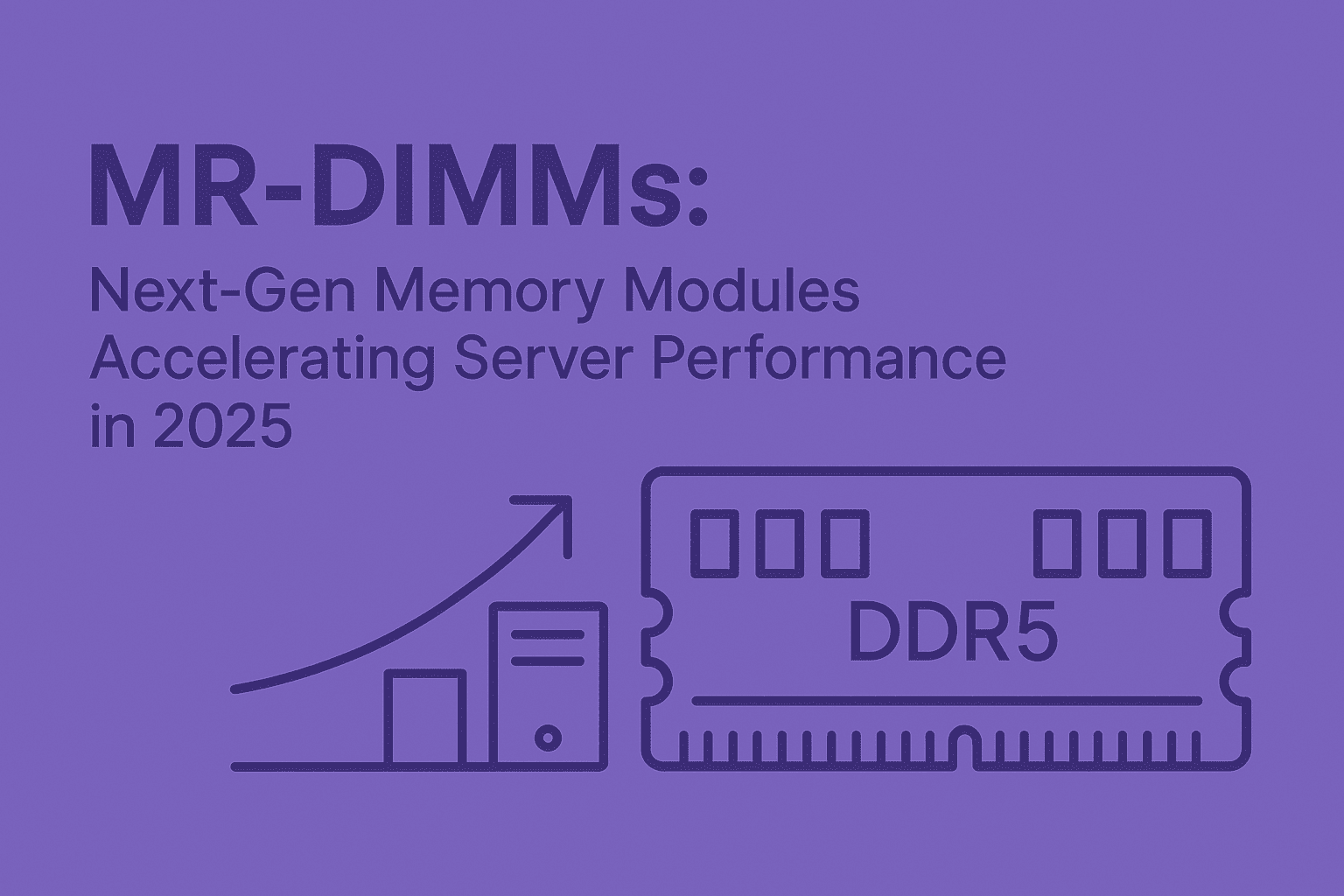
Modern servers are hungry for memory bandwidth and capacity. As CPU core counts skyrocket, feeding each core with data fast enough has become a critical bottleneck. Enter MR-DIMMs (Multiplexer Rank Dual In-line Memory Modules) – a new DDR5-based memory module architecture poised to dramatically boost server performance. MR-DIMMs, standardized by JEDEC in 2024, use clever on-DIMM multiplexing to double data transfer rates per memory channel without changing the server’s DIMM slots or DDR5 interface. This technical blog post provides an overview of MR-DIMM architecture and how it differs from conventional DDR5 DIMMs, the key benefits it brings (higher bandwidth, better capacity scaling, power efficiency, future CPU support), performance comparisons with traditional memory, and the workloads and adoption trends relevant in 2025.
Check out our latest Custom Supermicro GPU Servers for all needs.
Understanding MR-DIMM Architecture vs. Standard DDR5
What is an MR-DIMM? At its core, an MR-DIMM is still a DDR5 DIMM, but with additional logic that enables two ranks of DRAM to operate in parallel on one module. In a traditional DDR5 DIMM, only one rank (a set of memory chips) is accessed at a time, delivering a 64-byte cache line per memory access to the CPU (64 bytes = 64 bits × 8 beats). MR-DIMMs instead activate two ranks simultaneously and combine their data, effectively delivering 128 bytes per memory access cycle to the CPU – doubling the data throughput per channel. This is achieved through on-module buffering and multiplexing hardware that isn’t present on standard Registered DIMMs (RDIMMs).
Figure: Conceptual operation of an MR-DIMM. Two ranks (Rank 0 and Rank 1) each supply 64 bytes of data concurrently into a high-speed on-DIMM data buffer, which multiplexes them into a single 128-byte transfer to the server CPU. This effectively doubles the data delivered per memory cycle compared to a traditional DDR5 DIMM.

How it works: MR-DIMMs include extra silicon on the module to orchestrate this parallel access and high-speed data mux/demux. A special chip called the MRCD (Multiplexing Registering Clock Driver) replaces the usual register; it receives memory commands from the host at twice the normal rate, then splits and routes them to two ranks in parallel. Meanwhile, multiple MDB (Multiplexing Data Buffer) chips (typically 10 per module, five for each 40-bit DDR5 subchannel) sit between the DRAM chips and the host interface. Each MDB takes a 16-bit data path from two DRAM devices (one from each rank) and multiplexes it onto an 8-bit bus at double speed for the host. In essence, the DRAM devices on an MR-DIMM run at half the host data rate, but by ganging them together, the module outputs data at double width (in time-multiplexed fashion) to the CPU. This design allows the memory channel to achieve twice the throughput without adding extra pins or channels to the system. Importantly, MR-DIMMs still use the same DDR5 electrical interface, pinout, SPD firmware, and PMIC (power management) components as normal DDR5 modules, making them a drop-in solution at the platform level (provided the CPU memory controller supports the MR-DIMM mode).
Key architectural differences vs. DDR5 RDIMM: The table below summarizes how MR-DIMMs contrast with conventional DDR5 RDIMMs in 2025:
- Parallel Rank Access: Standard DDR5 RDIMMs access one rank at a time (64-byte transfer), whereas MR-DIMMs access two ranks in parallel for a 128-byte transfer. This parallelism is transparent to software – the memory controller and MR-DIMM hardware handle it internally.
- On-DIMM Buffering: RDIMMs have a registering clock driver to buffer command/address signals, and DDR5 RDIMMs also include some data buffers for signal integrity at high speeds. MR-DIMMs go further by adding the MRCD and a network of data buffers that actively multiplex data streams. This is conceptually similar to Load-Reduced DIMMs (LRDIMMs) but with data interleaving between ranks, not just load isolation.
- Effective Data Rate: A DDR5-6400 RDIMM delivers 6.4 GT/s per pin (e.g. 51.2 GB/s per channel with 64-bit data). An MR-DIMM using the same DRAM chips can deliver an effective 8.8 GT/s per pin to the host – because it’s outputting two DRAM words per cycle. In practice, Gen1 MR-DIMM modules are rated at DDR5-8800 speeds, using on-DIMM multiplexing of DDR5-4400 or 4800 signals from each rank.
- Module Capacity: MR-DIMMs can support more ranks per module than typical RDIMMs. With the buffering isolating the load on the host memory bus, memory vendors can put four or even eight ranks (organized as parallel-access pairs) on a module without overwhelming the memory channel. This means MR-DIMMs can reach very high capacities (256 GB or more per module) using current DRAM densities, often by employing a taller DIMM form factor to accommodate extra chips (more on this below).
Despite these differences, MR-DIMMs are designed for compatibility. They maintain the same RAS (reliability, availability, serviceability) features as standard RDIMMs and plug into the same DDR5 slots. The key requirement is that the server’s memory controller must explicitly support MR-DIMM operation. Major CPU vendors have been collaborating on this standard – for example, Intel’s 6th Gen Xeon Scalable “Granite Rapids” processors introduced in late 2024 include native support for MR-DIMM (DDR5-8800) alongside standard DDR5-6400 memory. AMD has also contributed to the JEDEC spec and is expected to support MR-DIMMs in future EPYC processors (though the 5th Gen “Turin” EPYC in 2024 was still limited to standard DDR5).
Key Benefits of MR-DIMM Technology
Server architects are eyeing MR-DIMMs because they promise to break through memory bottlenecks in ways conventional DIMMs cannot. Below we outline the major benefits MR-DIMMs bring to server platforms:
- Higher Memory Bandwidth per Channel: The most direct benefit of MR-DIMMs is substantially increased memory bandwidth. By delivering two ranks’ worth of data in each cycle, an MR-DIMM approximately doubles the peak throughput of a memory channel. For example, first-generation DDR5 MR-DIMMs run at an effective 8,800 MT/s, versus 4,800–6,400 MT/s for typical DDR5 modules. In practical terms, Micron reports up to a 39% increase in effective memory bandwidth per channel over same-generation RDIMMs. SK hynix similarly demonstrated that its early “MCR DIMM” (a variant of MR-DIMM) could reach 8.0 Gbps per pin, delivering 66% more bandwidth than a conventional DDR5-4800 module. This bandwidth boost scales with the number of channels: a server with 12 memory channels of MR-DIMM can hit staggering memory throughput numbers (e.g. ~844 GB/s on a 2-socket platform, vs ~614 GB/s with 6400 MT/s RDIMMs). The increased bandwidth directly benefits memory-intensive workloads by reducing stalls and feeding CPUs with data at a rate more commensurate with their computing power.
- Improved Memory Capacity and Scalability: MR-DIMMs also unlock higher memory capacity per module and per system. The architecture supports more than two ranks per DIMM, which means vendors can populate modules with extra DRAM devices (or higher-density chips) without running into electrical loading limits on the bus. In practice, standard-height MR-DIMMs are being offered up to 256 GB (using 32 Gb DDR5 chips and dual-rank x8 configurations) and tall form factor (TFF) MR-DIMMs can also reach 256 GB using only single-die components (no TSV stacking). The Tall MRDIMM specification simply extends the PCB height to accommodate roughly twice the number of DRAM packages, enabling very high capacity in 2U+ servers. For example, Micron’s first MR-DIMM lineup includes 32 GB, 64 GB, 96 GB, 128 GB, and 256 GB modules without any 3D stacking, plus 256 GB “tall” modules for even better thermals. More capacity per DIMM means fewer total DIMM slots needed to meet memory footprint requirements, which simplifies motherboard routing and can reduce overall power. MR-DIMMs thus improve scalability for memory capacity in dense servers or memory-bound applications.
- Lower Memory Latency (at High Loads): An interesting advantage of MR-DIMMs is their potential to reduce effective memory latency in heavy workloads, even though additional chips are involved on the DIMM. Because each rank in an MR-DIMM operates at a lower clock rate internally (half the data rate) and the data buffer orchestrates the transfer, the memory can achieve tighter timing parameters than a single rank running at full speed. Micron and Intel have reported that a 128 GB DDR5-8800 MR-DIMM shows up to 40% lower loaded memory latency compared to a 128 GB DDR5-6400 RDIMM in the same system. In other words, under a fully loaded memory access pattern, the MR-DIMM’s parallel access and buffering reduce queueing delays, delivering faster responses to the CPU. This benefit helps ensure that the raw bandwidth gains translate into real-world performance improvements for applications (latency being as important as throughput for many workloads).
- Better Power Efficiency and Thermal Management: MR-DIMMs are designed to provide more bandwidth per watt of memory power consumed. Rather than pushing DRAM chips to extreme high-frequency operation (which exponentially increases power usage), MR-DIMMs achieve high throughput by running chips at moderate speeds in parallel. This leads to a more efficient use of power. Micron notes that MR-DIMM technology “significantly lowers the amount of energy used per task” compared to traditional DIMMs, and provides higher performance per watt. A concrete example: by using 32Gb DRAM dies in a 256GB MR-DIMM, they can keep the module’s power envelope similar to a 128GB module with 16Gb dies, effectively doubling capacity with no power penalty. Moreover, the Tall MR-DIMM form factor improves cooling — the larger PCB surface area and better airflow around chips can reduce DRAM temperatures by ~20°C under the same conditions. Cooler memory operates more efficiently and is less prone to throttling. All these factors contribute to MR-DIMMs delivering high bandwidth in a more power-efficient manner than simply cranking up DDR5 clock speeds.
- Support for Next-Generation CPUs (Future-Proofing): MR-DIMMs are an investment in future-ready infrastructure. Because they adhere to DDR5 standards at the electrical level, they are being enabled on upcoming server CPU platforms without requiring exotic new memory controllers. Intel’s latest Xeon processors (Xeon 6th Gen “Granite Rapids” in 2024) already support MR-DIMMs alongside standard DIMMs, giving system builders the option to mix high-bandwidth MR-DIMM memory for critical workloads while retaining compatibility. AMD, which announced collaboration on MR-DIMM standards, is expected to incorporate support in its future EPYC generations as welll. By deploying MR-DIMMs, data centers can future-proof their servers, ensuring that memory does not become the choke point as new CPU generations with even more cores and higher IO come to market. In short, MR-DIMM technology scales bandwidth and capacity per core to meet the demands of next-gen compute platforms. It offers a path forward for the DDR5 ecosystem so that server memory can keep up with trends like 8+ memory channels per socket and 100+ cores per socket, extending the useful life of DDR5 well into the future.
- Seamless Ecosystem Integration: Finally, it’s worth noting that MR-DIMMs retain the same RAS features, error correction, and fundamental interfaces as existing DDR5 RDIMMs. They are engineered as drop-in upgrades (with CPU support) rather than requiring a whole new memory technology. This means IT teams can adopt MR-DIMMs without needing special software or OS changes – standard memory controllers see either a higher data rate DIMM or handle the multiplexing at the firmware level, with no OS intervention. Leading server OEMs (Lenovo, Dell, HPE, etc.) are validating MR-DIMMs in their next-gen platforms to ensure stability across workloads. From a cost perspective, MR-DIMMs leverage mature DDR5 manufacturing and packaging processes (in fact, many MR-DIMMs avoid expensive 3D-stacked DRAM by using the tall form factor instead). This helps keep the cost per bit reasonable while achieving performance gains. All these factors make MR-DIMMs an attractive, low-disruption upgrade for enhancing memory performance.
Performance Comparison: MR-DIMM vs Traditional DDR5 DIMM
How much real acceleration can MR-DIMMs provide? Early benchmarks and vendor data indicate significant improvements in memory subsystem performance:
- Bandwidth Gains: As discussed, MR-DIMMs roughly double the theoretical peak bandwidth of a memory channel. JEDEC notes that MR-DIMM modules deliver “up to twice the peak bandwidth of native DDR5 DRAM” on a given channel. In concrete numbers, if a server DIMM slot currently delivers ~25–30 GB/s (with DDR5-4800 to 6400), an MR-DIMM can boost that towards ~50–60+ GB/s per slot. Micron’s testing shows ~39% higher effective bandwidth on first-gen MR-DIMM (8800 MT/s) vs. a top-bin DDR5 RDIMM (6400 MT/s). In future generations, as MR-DIMMs scale to 12.8 GT/s (DDR5-12800) and beyond, bandwidth per channel could increase by 45% or more over the equivalent RDIMM. This is a massive uplift considering how memory bandwidth usually increases only incrementally. For memory-bound applications, a 1.4–1.8× boost in throughput can directly translate to similar gains in processing throughput.
- Latency and Throughput Under Load: One key metric is loaded latency – the delay to service memory requests when the memory subsystem is busy. Here MR-DIMMs shine compared to load-reduced or 3DS RDIMMs of high capacity. As noted, a 128 GB MR-DIMM at 8800 MT/s shaved up to 40% off memory latency relative to a 128 GB 6400 MT/s RDIMM in Intel’s measurements. This means applications with random memory accesses or heavy multi-threaded memory traffic will see not just higher bandwidth ceiling but snappier memory response. Additionally, MR-DIMMs improve the bus efficiency – Micron cites over 15% better bus utilization, meaning fewer idle cycles on the memory bus and more useful data transferred. This comes from the fact that the memory controller can schedule operations to two ranks in parallel and the bus is effectively always busy transferring one rank’s data or the other’s. In summary, MR-DIMMs make more out of each memory clock cycle.
- Power-Performance: Another comparison point is how much power it takes to reach a certain bandwidth. Driving standard DDR5 to very high speeds (7200 MT/s and beyond) incurs exponential power and heat due to faster signal toggling and timing guardbands. MR-DIMMs achieve comparable or better performance at lower per-pin speed, which tends to be more power-efficient. According to Micron, MR-DIMMs “significantly lower the energy per task” while delivering higher performance. They also reported that a 256GB MR-DIMM outperforming a 256GB TSV-stack RDIMM did so within the same power envelope. This implies better performance-per-watt, an important metric for data center TCO. In practice, deploying MR-DIMM can reduce the number of total DIMMs (due to higher capacity each) and possibly allow running at slightly lower voltages or fewer ranks active at once for the same throughput, all contributing to power savings.
It’s still early days for MR-DIMM benchmarking by independent parties. As of 2025, most performance data comes from memory vendors and early platform previews. However, the consensus from these sources is that MR-DIMMs unlock performance that was previously unattainable with conventional DIMMs. Intel showcased scenarios where enabling MR-DIMM on a Granite Rapids server boosted HPC and AI application performance significantly over the previous-gen platform – in some cases contributing to over 2× overall gain, alongside more cores and cache. While those gains are not solely from memory, the memory speedup is a crucial piece for workloads that were starved for bandwidth. We can expect more benchmark data to emerge as MR-DIMMs become widely available, but the early figures strongly indicate that memory no longer has to be the slow lane in a server.
Workloads and Environments That Benefit Most
Not every application will immediately need MR-DIMM-level performance, but certain types of server workloads are poised to benefit greatly from this technology:
- High-Performance Computing (HPC): Scientific simulations, modeling, and engineering applications often stream huge data arrays from memory or perform frequent random accesses to large datasets. HPC codes (like finite element analysis, weather modeling, fluid dynamics, etc.) tend to be memory-bandwidth bound on modern CPUs. MR-DIMMs can provide the bandwidth headroom needed for these applications to scale across dozens of cores without saturating memory channels. Intel reported that HPC workloads saw 2.3×–3.1× higher performance on their new platform with MR-DIMM and other improvements, compared to the prior-gen. Even discounting CPU improvements, a large part of that comes from memory bandwidth gains and lower memory latency. With MR-DIMMs, HPC clusters can achieve better performance per node or use fewer nodes to reach the same performance, which is compelling for both efficiency and cost. As MR-DIMMs allow very large memory per socket (e.g. 8 × 256GB = 2 TB per socket with fewer slots), memory-intensive HPC tasks can also keep more data in RAM, reducing slower disk I/O.
- Artificial Intelligence and Machine Learning: AI/ML workloads, especially those involving large neural model inference or training on CPUs, benefit from maximum memory throughput. While many AI workloads offload to GPUs (which use HBM memory), there are emerging CPU-based AI use cases (e.g. real-time inference on big CPU clusters, AI databases, vector search) that rely on main memory speed. Even GPU-accelerated training can be bottlenecked by CPU host memory when preparing batches of data or handling model parameters that don’t fit on the GPU. MR-DIMMs help ensure each CPU core feeding a GPU or running an inference thread gets ample bandwidth. They close the bandwidth gap for memory-intensive workloads like AI inference and retraining, as noted by industry experts. In fact, industry analysts predict MR-DIMMs could become the preferred main memory solution for future AI and HPC systems, complementing high-bandwidth on-package memories by vastly boosting the capacity and bandwidth of regular RAM. In sum, any AI workload that scales with more CPU memory bandwidth (e.g. deep learning inference servers, recommendation systems, large graph analytics) can see direct improvements from MR-DIMM adoption.
- Virtualization and Cloud Multi-Tenancy: In cloud data centers and virtualized enterprise environments, it’s common to pack many virtual machines or containers onto a single physical server. This multi-tenant scenario results in highly random memory access patterns and sometimes extreme memory bandwidth pressure, as dozens of VMs compete for the same memory channels. MR-DIMMs are well suited here: they deliver more aggregate bandwidth and lower latency under load, which translates to better quality of service for each VM. Micron specifically calls out “memory-intensive virtualized multi-tenant workloads” as a target, where MR-DIMM provides the highest bandwidth and improved performance per watt to accelerate these scenarios. For cloud providers, MR-DIMMs can help ensure that increasing CPU core counts (for example, 128-core processors servicing many cloud users) do not outstrip the available memory throughput. The result is higher VM density per server and more consistent performance for memory-hungry cloud applications (databases, in-memory caches, analytics jobs, etc.). In addition, the extra capacity of MR-DIMMs lets cloud operators offer larger memory instances on a single DIMM socket (e.g. a 256 GB DIMM could support certain VM sizes with just one module, simplifying configuration).
- Large In-Memory Databases and Analytics: Workloads like SAP HANA, Oracle database in-memory option, big data processing, and real-time analytics rely on keeping massive data sets in RAM for speed. These can be both capacity-intensive and bandwidth-intensive. MR-DIMMs address both needs by allowing very large memory pools and speeding up data scans. For example, an in-memory database performing a full table scan or a join across large tables will complete faster with higher memory bandwidth. Similarly, high-frequency trading systems or financial analytics that keep working sets in memory could see lower latency spikes during peak processing. Essentially, any environment where memory is the critical resource (either due to dataset size or throughput requirements) stands to benefit from MR-DIMM technology.
It’s worth noting that not every workload saturates memory bandwidth. Some applications are more compute-bound or storage-bound, and they might not see dramatic gains from MR-DIMMs. However, given trends like data-hungry AI models and multi-core scalability, more workloads are shifting toward being memory-bound. MR-DIMMs ensure that such workloads can fully utilize advanced CPUs. They are particularly advantageous in balanced system design: instead of adding expensive specialty memory like HBM (which has limited capacity) for general-purpose servers, MR-DIMMs offer a mainstream way to uplift memory performance for a broad range of applications.
Industry Adoption and Outlook for 2025 and Beyond
MR-DIMMs are a cutting-edge innovation in 2025, but they are rapidly moving from prototypes to real products in the field:
- Standardization: JEDEC’s JC-45 committee (responsible for DRAM modules) finalized the DDR5 MRDIMM standard in mid-2024, laying out specifications for how these modules function and interface with CPUs. The standard aims for generational improvements – Gen1 MR-DIMM at 8.8 GT/s, Gen2 at 12.8 GT/s, and Gen3 at 17.6 GT/s in the future. In fact, JEDEC’s roadmap envisions doubling DDR5’s bandwidth via MR-DIMM techniques, maintaining the same core DDR5 technology but extending its performance envelope. Crucially, the JEDEC spec mandates that MR-DIMMs remain compatible with the RDIMM ecosystem and use standard DDR5 components as much as possible. This ensures broad industry support and eases the path to adoption.
- Memory Vendor Support: All major DRAM manufacturers have thrown their weight behind MR-DIMMs. Micron announced its first MR-DIMM products in July 2024 and began sampling them to customers and partners. Micron’s MR-DIMM family includes densities from 32 GB up to 256 GB, in both standard and tall form factors, targeted at HPC, AI, and data center use cases. Volume production is slated for the latter half of 2024, meaning that in 2025 many server OEMs will have these modules qualified in high-end systems. SK hynix demonstrated its “MCR DIMM” (which aligns with the MR-DIMM standard) back in late 2022 and, together with Intel and Renesas, proved the concept of 8 Gbps-pin memory operation. SK hynix is planning to launch its own MR-DIMM products for servers in 2H 2024, including modules built with its latest 32Gb DDR5 chips for HPC customers. Samsung has been somewhat quieter publicly, but as a leading memory maker and JEDEC contributor, Samsung is also expected to offer MR-DIMM modules — indeed, industry reports indicate that Samsung and even third-party module vendors like Adata have MR-DIMM offerings in development to coincide with new server platform launches. In short, the memory industry is gearing up so that MR-DIMMs will be readily available by the time servers can use them.
- CPU and Platform Support: On the processor side, Intel is first to market with MR-DIMM support. The 6th Gen Intel Xeon Scalable (Granite Rapids) officially supports DDR5-6400 RDIMMs and DDR5-8800 MR-DIMMs on its 12-channel memory subsystem. This gives Intel an edge in memory bandwidth against current-gen AMD servers. Intel has emphasized that its platform offers the flexibility to use standard DIMMs or MR-DIMMs in the same slots, so customers can choose based on their workload needs. AMD, meanwhile, is expected to catch up in a subsequent generation. The 5th Gen EPYC “Turin” launched in late 2024 did not include MR-DIMM capability (it topped out at DDR5-6000 to 6400 on 12 channels). This means AMD’s bandwidth per core is currently lower, as noted by analysts, since Intel can use MR-DIMMs to push far higher channel speeds. However, AMD had announced its involvement in developing MR-DIMM standards and hinted at future support up to 17.6 GT/s speeds. It’s reasonable to expect that AMD’s next server platform (possibly Zen 6 based EPYC) will introduce MR-DIMM support to stay competitive in memory performance. Server OEMs like Lenovo have already prepared for MR-DIMMs: for instance, Lenovo’s ThinkSystem servers with Intel Xeon 6th Gen will support MR-DIMMs out of the box, and they anticipate future AMD platforms to support them as well. With both major CPU vendors onboard (one now, one soon), MR-DIMMs have a clear runway to become a mainstream option in enterprise and cloud servers by 2025–2026.
- Real-World Deployments: The latter half of 2024 saw initial sampling and qualification, and 2025 is expected to bring the first large-scale deployments of MR-DIMM-enabled servers. Early adoption will likely be in high-end segments – e.g. supercomputing centers, cloud providers catering to AI workloads, and specialized HPC/AI appliance vendors. For example, one can imagine cloud instances advertising higher memory bandwidth (for HPC VMs) using MR-DIMM-equipped hardware, or AI hardware solutions (outside of GPUs) using MR-DIMM to feed CPU-based AI accelerators. Enterprise data centers with memory-constrained applications (like in-memory analytics) will start evaluating MR-DIMMs for performance boosts. Over time, as the tech proves its value, adoption could widen to general-purpose servers. A key point is that MR-DIMMs can lower the total cost of ownership (TCO) for memory in some scenarios. By getting more performance out of each DIMM and each server, organizations might purchase fewer servers to meet a given performance target. Additionally, MR-DIMMs’ high capacities mean fewer DIMMs (and potentially fewer memory channels) are needed for a large memory pool, simplifying system design. These economic incentives will drive adoption once the technology matures and volumes ramp up.
- Future Roadmap: Looking beyond 2025, MR-DIMMs are positioned to carry the DDR5 ecosystem through the rest of the decade. JEDEC’s plan to reach 12.8 Gbps (Gen2) and even 17.6 Gbps (Gen3) with MR-DIMM suggests that, rather than moving to a whole new memory type, the industry will extend DDR5 by leveraging MR-DIMM architecture. Gen2 MR-DIMMs (DDR5-12800) could appear by 2026–2027 timeframe, likely aligning with newer CPU generations, and offering ~45% better bandwidth per channel than Gen1. Gen3 might come later (perhaps around DDR6 introduction or as an alternative), pushing memory speeds into the mid-teens of GT/s. Each generation will also bring higher density DRAM chips, so we might see 512 GB MR-DIMMs on the horizon (using 64Gb dies or 3D stacking in combination with tall form factors). MR-DIMM technology might also influence future memory standards – for instance, some concepts from MR-DIMM (parallel rank access) could find their way into DDR6 or other memory architectures.
It’s important to contextualize MR-DIMMs in the broader landscape: they are one approach to solve the memory bandwidth problem, complementing other approaches like increasing channel count, using faster I/O like HBM, or new interconnects like CXL memory expander modules. MR-DIMMs have the advantage of working within the existing memory slot paradigm, which is cost-effective and flexible. While HBM (High Bandwidth Memory) offers extremely high bandwidth, it is expensive, limited in capacity, and used mainly on GPUs or specialty accelerators. MR-DIMMs, by contrast, provide a scalable, large-memory solution for CPUs – offering much higher bandwidth and capacity in standard DIMM form. This makes MR-DIMMs a likely choice for main memory in future AI, cloud, and enterprise servers where both bandwidth and capacity are needed in bulk.
In summary, MR-DIMMs represent a significant leap in memory technology for servers. As of 2025, they are turning what used to be a memory bandwidth wall into a new horizon – enabling memory speeds of 8.8 GT/s and beyond, larger DIMMs than ever, and more efficient use of each memory channel. For IT decision-makers and system architects, MR-DIMMs offer a practical path to scale memory performance alongside CPU advancements, ensuring that next-generation workloads (from AI to HPC to cloud services) can run faster and more efficiently. With initial products already available and broad industry backing, MR-DIMMs are set to become a key component in high-performance server architectures, bridging the gap between today’s DDR5 limitations and the demands of the coming decade. The acceleration of server performance through MR-DIMM memory is just beginning – and it will be exciting to watch how this technology reshapes data center capabilities in the years ahead.
Related Products
Comment(s)