We use cookies to make your experience better. To comply with the new e-Privacy directive, we need to ask for your consent to set the cookies. Learn more.

NVIDIA RTX PRO 6000 Blackwell vs RTX 6000 Ada (Server GPU Comparison)
Posted:
May 19, 2025
Categories:
General Topics and News
NVIDIA RTX PRO 6000 Blackwell vs RTX 6000 Ada (Server GPU Comparison)

NVIDIA’s RTX PRO 6000 Blackwell Server Edition is the next-generation GPU for enterprise servers, succeeding the RTX 6000 Ada generation. This new Blackwell-based card roughly doubles the memory capacity (96 GB GDDR7 vs 48 GB GDDR6) and offers a generational performance uplift (early benchmarks suggest ~14% higher throughput).
This new card is a powerful data center GPU for AI and visual computing. It accelerates demanding enterprise workloads, including AI, scientific computing, graphics, and video applications. The table below provides a clean spec-by-spec comparison of the RTX PRO 6000 Blackwell Server Edition versus the previous-gen RTX 6000 Ada:
Key Specifications Comparison
| Specification | NVIDIA RTX PRO 6000 Blackwell (Server Edition) | NVIDIA RTX PRO 6000 Blackwell (Workstation Edition) | NVIDIA RTX PRO 6000 Blackwell (Max‑Q Workstation Edition) | NVIDIA RTX 6000 Ada |
|---|---|---|---|---|
| Architecture | Blackwell (2025) – 9th Gen NVIDIA RTX Cores | Blackwell (2025) – 9th Gen NVIDIA RTX Cores | Blackwell (2025) – 9th Gen NVIDIA RTX Cores | Ada Lovelace (2022) – 8th Gen NVIDIA RTX Cores |
| GPU Memory | 96 GB GDDR7 with ECC | 96 GB GDDR7 with ECC | 96 GB GDDR7 with ECC | 48 GB GDDR6 with ECC |
| Memory Bandwidth | Up to 1.6 TB/s | ~1.792 TB/s | ~1.792 TB/s | ~960 GB/s |
| Max Power (TDP) | 400 W – 600 W (configurable) | 600 W | 300 W | 300 W |
| Graphics Bus | PCI Express 5.0 ×16 | PCI Express 5.0 ×16 | PCI Express 5.0 ×16 | PCI Express 4.0 ×16 |
| Form Factor | Dual-slot, Full‑Height/Full‑Length (10.5″ × 4.4″) – passive cooling (no fans) | Dual-slot, XHFL (5.4″ H × 12″ L) | Dual-slot, Full‑Height/Full‑Length (10.5″ × 4.4″) – active cooling (blower) | Dual-slot, Full‑Height/Full‑Length (10.5″ × 4.4″) – active cooling (blower) |
| Display Outputs | 4× DisplayPort 2.1 | 4× DisplayPort 2.1 | 4× DisplayPort 2.1b | 4× DisplayPort 1.4a |
| Multi-Instance GPU | Yes – up to 4 virtual GPUs (4×24 GB) | Yes – up to 4 virtual GPUs (4×24 GB) | Yes – up to 4 virtual GPUs (4×24 GB) | Not supported |
Please note that in this discussion we are referring specifically to the Server Edition. The NVIDIA RTX Pro 6000 Blackwell is actually a family comprising three distinct variants:
- Server Edition: A passively cooled successor to the NVIDIA L40, L40S, and A40.
- Workstation Edition: Features a large active cooler—similar to those on desktop GeForce cards—designed for a single, high‑performance GPU in a workstation chassis.
- Max‑Q Workstation Edition: Employs a blower‑style cooler optimized for multi‑GPU setups, much like the NVIDIA RTX 6000 Ada Generation.

Key Use Cases
- Virtual Desktop Infrastructure (VDI): Supports multiple high-performance virtual workstations on one GPU. The 96 GB VRAM and MIG feature allow partitioning the GPU for up to four concurrent VDI users, each with ample memory for graphics-intensive desktops.
- Rendering & 3D Graphics: Ideal for professional rendering farms and 3D visualization. The Blackwell GPU’s doubled memory and newer RTX cores accelerate real-time rendering, GPU-accelerated design (CAD/DCC), and VR simulations, handling larger scenes and models than the RTX 6000 Ada.
- AI & Deep Learning: Enhanced AI training and inference performance for enterprise AI workloads. With 96 GB of ECC memory and 5th-gen Tensor Cores, the RTX PRO 6000 Blackwell can train larger models or run more complex inference tasks on a single card (especially useful for generative AI and large language models), outperforming the previous-gen card in AI throughput.
- Simulation & Scientific Computing: Suited for simulation, data science, and HPC-lite workloads. The increased memory bandwidth and compute capabilities enable faster iterations in engineering simulations (CAE, CFD) and data analytics, while the PCIe Gen5 interface provides higher data transfer rates for I/O-intensive tasks.
Compatible Server Hardware Examples
For enterprise buyers planning to deploy the RTX PRO 6000 Blackwell, a range of certified servers can accommodate these GPUs:
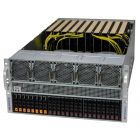
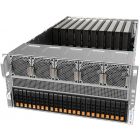
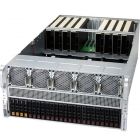
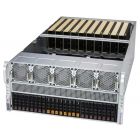
- Supermicro GPU SuperServer SYS‑521GE‑TNRT – High‑density 5U platform supporting up to 10 RTX PRO 6000 cards with quad Xeon processors and enterprise power/cooling.
- 5U Multi‑GPU Rack Servers – Enterprise 5U servers optimized for 4–8 passive‑cooled GPUs, redundant PSUs, and high airflow.
- Here you can explore all solutions compatible with the RTX PRO 6000 Blackwell: All Blackwell‑capable Servers.
This next-gen RTX PRO 6000 Blackwell Server Edition delivers a significant leap for enterprise GPU computing – combining massive memory, higher performance, and data-center features to power virtualization, graphics, and AI workloads in modern server deployments. Its improvements over the RTX 6000 Ada make it a compelling choice for organizations seeking to future-proof their GPU-accelerated infrastructure.
Related Products
Comment(s)