We use cookies to make your experience better. To comply with the new e-Privacy directive, we need to ask for your consent to set the cookies. Learn more.

NVIDIA H200 vs H100: A Technical Deep Dive
Posted:
November 13, 2024
Categories:
General Topics and News
NVIDIA H200 vs H100: A Technical Deep Dive

The NVIDIA H100 and H200 are both high-performance GPUs designed for demanding tasks in AI, deep learning, and HPC. The H200 represents a step forward in terms of memory bandwidth, power efficiency, and overall performance, catering to the growing need for more complex computations and larger model handling capabilities. Let’s explore these GPUs by comparing their specifications, architecture, and performance metrics.
NVIDIA H200 GPUs, announced in late 2023, are now available as of 2024, and offer unprecedented performance improvements for AI and HPC workloads. At Server Simply, we offer custom servers equipped with the latest H200 and H100 GPUs, tailored to meet the unique requirements of your applications.
Specifications Comparison
The core specifications reveal that the H200 has significant improvements in GPU memory, memory bandwidth, and maximum thermal design power (TDP) compared to the H100.
| Specification | NVIDIA H100 SXM | NVIDIA H200 SXM |
|---|---|---|
| FP64 | 34 TFLOPS | 34 TFLOPS |
| FP64 Tensor Core | 67 TFLOPS | 67 TFLOPS |
| FP32 | 67 TFLOPS | 67 TFLOPS |
| TF32 Tensor Core | 989 TFLOPS | 989 TFLOPS |
| BFLOAT16 Tensor Core | 1,979 TFLOPS | 1,979 TFLOPS |
| FP16 Tensor Core | 1,979 TFLOPS | 1,979 TFLOPS |
| FP8 Tensor Core | 3,958 TFLOPS | 3,958 TFLOPS |
| INT8 Tensor Core | 3,958 TOPS | 3,958 TOPS |
| GPU Memory | 80GB | 141GB |
| GPU Memory Bandwidth | 3.35TB/s | 4.8TB/s |
| Max TDP | Up to 700W | Up to 1000W |
| Decoders | 7 NVDEC, 7 JPEG | 7 NVDEC, 7 JPEG |
| Interconnect | NVLink: 900GB/s, PCIe Gen5: 128GB/s | NVLink: 900GB/s, PCIe Gen5: 128GB/s |
As shown, the H200 offers a substantial increase in memory and bandwidth, which is crucial for handling large AI models and datasets. The increased TDP (up to 1000W) indicates a higher power requirement but also implies improved processing power.
Throughput and Performance
Offline and Server Throughput
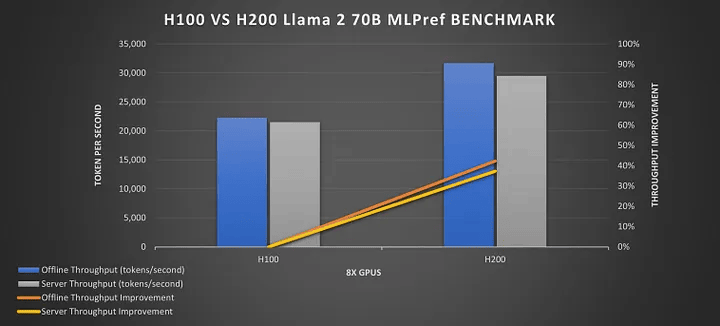
Based on the benchmark results with Llama 2 70B on 8x GPUs, we see notable improvements in the H200’s offline and server throughput over the H100.
- Offline Throughput: The H200 demonstrates a higher offline throughput, reaching closer to 30,000 tokens per second, compared to the H100.
- Server Throughput: Similar gains are observed in server throughput, showcasing the H200’s efficiency in multi-GPU environments, which is especially relevant for data centers and large-scale deployments.
The improved throughput metrics suggest that the H200 is optimized for faster data processing and can handle more substantial workloads, ideal for enterprises requiring high server availability and speed. For more insights on optimizing GPU server performance, check out our guide on How to Use GPU Servers for Maximum Computational Efficiency.
HPC Application Performance
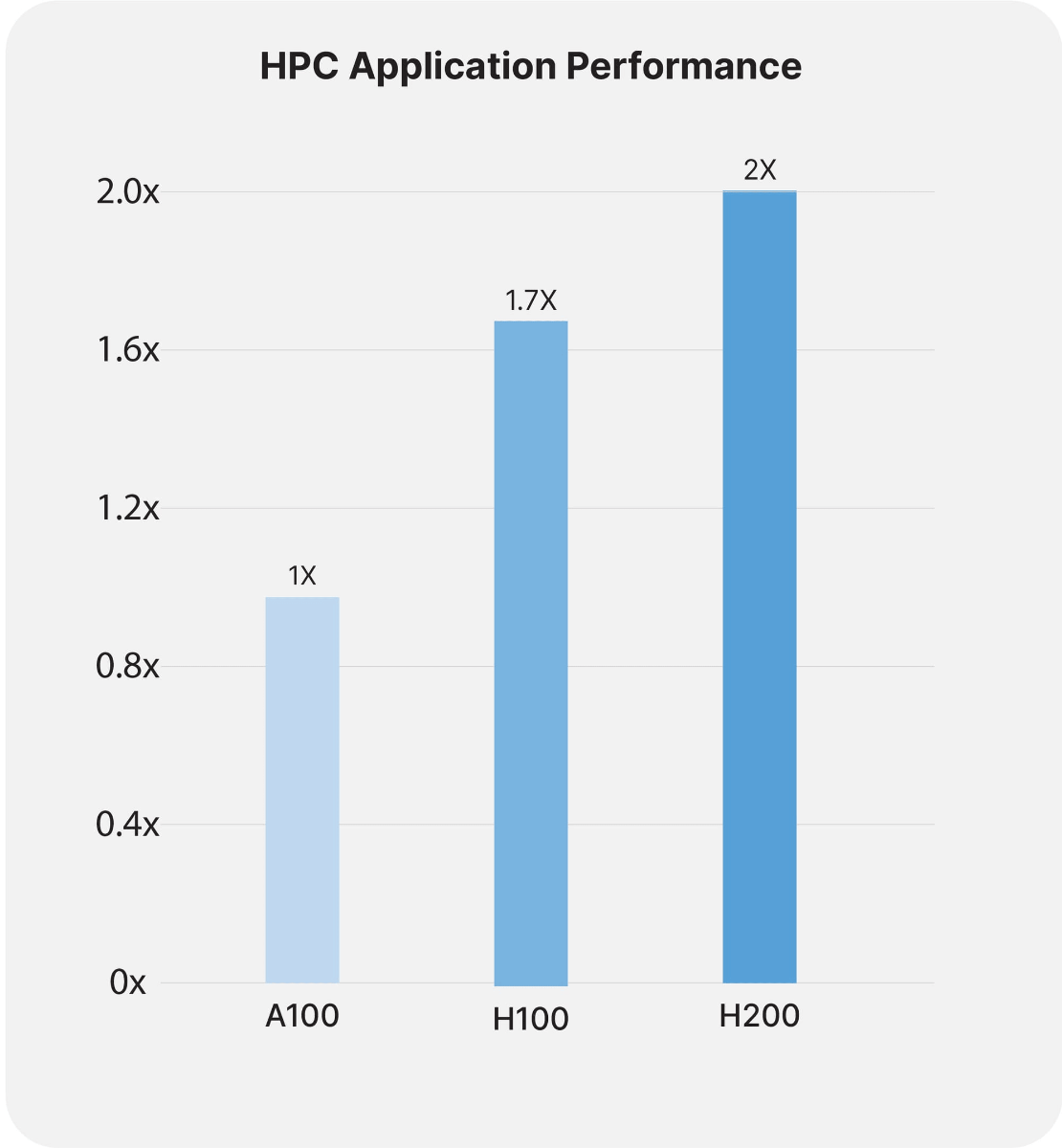
The HPC application performance graph shows that the H200 doubles the performance of the A100 and surpasses the H100 by approximately 17%, making it a powerful choice for complex scientific simulations, engineering computations, and other HPC applications.
- HPC Performance: The H200 achieves a 2x performance over the A100, while the H100 shows a 1.7x improvement. This incremental jump illustrates the H200’s advancement in handling HPC workloads efficiently.
The H200’s superior performance can be attributed to its increased memory bandwidth and optimized architecture, making it a strong candidate for organizations looking to maximize their computational throughput.
Practical Applications and Benefits
AI Model Training and Inference
The increased memory capacity and bandwidth in the H200 provide substantial benefits for training large language models and other data-intensive AI tasks. With 141GB of GPU memory, it is better suited for handling extensive datasets without needing to offload data frequently, thereby reducing latency and enhancing performance in inference and training stages.
Enhanced Multi-GPU Performance
Both the H100 and H200 are capable of multi-instance GPU (MIG) partitioning, which allows multiple instances per GPU, enhancing flexibility and maximizing utilization in cloud and data center environments. However, the H200’s added memory and power efficiency make it particularly advantageous for large-scale parallel processing, reducing inter-GPU communication bottlenecks.
Edge in Video Decoding and Compression
Both GPUs have similar video decoding and JPEG compression capabilities with 7 NVDEC and 7 JPEG decoders, which supports real-time processing of high-resolution video streams. This feature is essential for applications in media processing, autonomous driving, and smart cities where real-time data is critical.
Conclusion
The NVIDIA H200 marks a significant leap from the H100, offering superior memory, bandwidth, and processing power, tailored for the ever-increasing demands of AI and HPC workloads. While the H100 remains a powerful option, the H200’s enhanced capabilities make it ideal for organizations looking to future-proof their infrastructure and handle large-scale AI applications efficiently.
For companies like Server Simply, the H200 represents an opportunity to offer cutting-edge server solutions that cater to the next generation of AI and HPC needs. We offer 5U - 10U Rackmount Servers and the H200 SYS-822GA-NBRT Supermicro GPU SuperServer, equipped with the latest H200 and H100 GPUs, to deliver exceptional performance and value for your tasks.
Comment(s)