We use cookies to make your experience better. To comply with the new e-Privacy directive, we need to ask for your consent to set the cookies. Learn more.

Supermicro SYS-112D-40C-FN8P: 40-Core Xeon 6 SoC Telco Edge Server
Posted:
July 29, 2026
Categories:
General Topics and News
Supermicro SYS-112D-40C-FN8P
Intel Xeon 6716P-B · 40 cores
8× 25GbE SFP28 on-SoC
Intel vRAN Boost
399 mm depth · front I/O
Telco and edge infrastructure rarely fails because the server lacks raw compute. It fails because the cabinet is too shallow, rear access is impossible, timing is strict, and every added NIC or accelerator becomes another integration and support problem. The Supermicro SYS-112D-40C-FN8P answers that by combining a 40-core Intel Xeon 6 SoC, eight 25GbE ports, vRAN Boost and carrier-grade timing in a 399 mm front-I/O 1U platform built for rollout across real edge sites.
Short answer
A 399 mm deep 1U platform with a 40-core Intel Xeon 6716P-B (2.5 GHz base, 160 MB cache, 235 W) carrying Intel vRAN Boost and Speed Select Technology. Eight 25GbE SFP28 ports come from the Intel E825-C inside the SoC, so you get 8× 25GbE without add-in NIC cards and vRAN acceleration without a separate FEC card. Up to 512 GB DDR5-6400 across four DIMMs, up to two PCIe Gen5 x16 full-height slots with support for one single-width accelerator, two internal 2.5-inch U.2 NVMe bays, redundant 800 W Platinum supplies, GNSS and 1PPS timing on front SMA connectors, and a dry contact port for cabinet alarms. Every connector faces forward; the rear is exhaust only.
Best fit for
- Telco edge, MEC, vRAN/ORAN and 5G distributed unit deployments
- Sites with shallow cabinets, wall-mounted racks or one-sided service access
- Rollouts where 8× 25GbE and FEC acceleration would otherwise consume PCIe slots
- Multi-site deployments where repeatability, spares and logistics matter
- Cabinets requiring GNSS/1PPS timing and dry contact alarm integration
Not ideal for
- Normal data-center racks where full depth and rear access are not a problem
- Storage-heavy workloads that need external hot-swap bays
- GPU-heavy workloads requiring more than one single-width accelerator
- Workloads needing more than 40 cores or more than 512 GB per node
- Cases where timing, FEC and high port count are irrelevant
Need 8× 25GbE and vRAN acceleration in a shallow rack?
Send us your cabinet depth, port count and rollout plan, and we will return a matched SYS-112D-40C-FN8P configuration with EU pricing and a confirmed lead time.
Why buy through SERVER SIMPLY
We turn the server SKU into a deployable edge configuration — memory, NVMe, expansion cards, warranty, cabinet depth, power, timing and rollout schedule. For multi-site deployments we confirm pricing, availability and delivery timelines before you commit.
On this page
14-minute read- Why integrated 25GbE and vRAN Boost matter
- Front I/O and why depth matters
- Fitting it into a rack
- The front panel, port by port
- Inside the chassis
- How the platform is wired
- GNSS timing and why telecom needs it
- Where it gets deployed
- Configuration examples
- Specifications at a glance
- How it compares to the alternatives
- Deployment checklist for telecom cabinets
- When this is the wrong server
- How SERVER SIMPLY helps you deploy
- FAQ
Why integrated 25GbE and vRAN Boost matter
Build a conventional 1U node for a telecom site and the expansion slots disappear before you have added anything useful. Eight 25GbE ports means two quad-port NICs. Forward error correction for a virtualised radio access network means a dedicated accelerator card. That is three cards, three sourcing lines, three things to power and cool, and no slots left.
Intel's Xeon 6 SoC — Granite Rapids-D — puts both functions inside the processor package. The Intel Ethernet E825-C drives eight SFP28 cages straight from the die, and Intel vRAN Boost provides the FEC acceleration that previously required an add-in card. What is left over is the whole point.
Conventional telco build
Everything arrives as a separate card
- Quad-port 25GbE NICslot 1
- Quad-port 25GbE NICslot 2
- FEC / vRAN accelerator cardslot 3
Slots left for the actual workload
0
SYS-112D-40C-FN8P
Both functions live inside the processor
Intel Xeon 6 SoC 6716P-B
Intel E825-C → 8 × 25GbE SFP28
Intel vRAN Boost → FEC acceleration
PCIe Gen5 x16 slots still free
2
For an operator this is not a performance argument, it is a bill-of-materials argument. Two fewer part numbers per node, two fewer NIC SKUs to qualify, two fewer components to hold as spares, two fewer things to fail in a cabinet nobody visits often. Across a hundred sites, that is the difference between a rollout and a logistics problem.
Front I/O and why depth matters
At 399 mm — 15.7 inches — this chassis is roughly half the depth of a standard rack server. That number exists because telecom cabinets, street enclosures and retail back-office racks were never built to data-center dimensions, and many of them are mounted flat against a wall. A front-I/O 1U server for one-sided service access is not a niche preference at the edge; it is often the only thing that installs.

15.7 inches front to back — the single number that decides whether this platform fits a site or not.
Conventional rack server
750–850 mm deep
All I/O at the rear. Needs a deep cabinet and access from both sides — service means walking round to the hot aisle.
SYS-112D-40C-FN8P
399 mm deep
Every connector on the front. Fits shallow and wall-mounted cabinets, and the rear is airflow only — one-sided service.
Fitting it into a rack
A conventional server dictates the infrastructure around it. Needing 800 to 1000 mm of cabinet depth is not a specification detail — it decides which sites are possible at all, and cell towers, street-level enclosures and retail back rooms rarely qualify. Cutting the chassis to 399 mm inverts that relationship: the cabinet stops being the constraint and becomes a choice.
FRONT
REAR
Conventional
1000 mm cabinet
850 mm server
I/O at the rear — deep cabinet, access needed from both sides.
Shallow telecom rack
600 mm cabinet
399 mm
All I/O at the front — cable clearance sits ahead of the chassis, and the rear is exhaust only, so no rear access is needed. Fits wall-mounted and ruggedised enclosures.
Back-to-back
1000 mm cabinet
399 mm
399 mm
Two nodes in one footprint — each serviced from its own side of the cabinet. Exhausts meet in the middle, so plan the airflow.
0
500 mm
1000 mm
Cabinet selection
At 399 mm you can specify shallow telecom racks, ruggedised wall-mounted enclosures or standard cabinets — instead of being forced into whichever deep cabinet the server demands.
Back-to-back mounting
Two units fit rear-to-rear in a standard-depth cabinet, doubling the node count per square metre. Front I/O is what makes it practical — each unit is serviced from its own side, neither needs access past the other.
Floor space and leases
Remote edge sites are rented by footprint. Halving the depth reduces the real estate a deployment consumes, which becomes a negotiating position when you multiply it across sites.

Rail installation: the chassis slides onto inner rails already fitted to the cabinet posts, with the release latch shown in the detail views.
One caveat on the back-to-back layout. Airflow runs front to back, so mounting two units rear-to-rear puts their exhausts facing each other. That works in cabinets designed for it — with a central chimney or a vented mid-panel — but not in a sealed enclosure where the hot air has nowhere to go. Confirm the cabinet's airflow design before committing to the layout, not after.
The front panel, port by port
Everything a technician touches lives on one face, and the mix says more about the intended workload than any spec line. Grouped by purpose rather than by position:
Power
2 × 800 W PlatinumRedundant and hot-swap from the front — replacing one never requires rear access.
Management
IPMI on copper and fibreShared IPMI on RJ45 and on SFP28, two USB ports, mini DisplayPort, power button and status LEDs.
Data
8 × SFP28 25GbEDriven by the Intel E825-C inside the SoC — no add-in card, no expansion slot consumed.
Timing & site signalling
3 × SMA and a dry contactGNSS antenna, 1PPS in and 1PPS out, plus a dry contact RJ45 for cabinet alarm circuits.
Two details are worth pausing on. Management is available both on a dedicated RJ45 and on a shared SFP28 port, so a site that runs only fibre does not need a separate copper drop just for IPMI. And the dry contact RJ45 is pure telecom heritage: it wires the server into the cabinet's alarm circuit — door sensors, temperature, power failure — the way traditional network equipment has always reported site conditions.

Supermicro's own front-panel map. Every connector on this face, and nothing on the back.
Inside the chassis
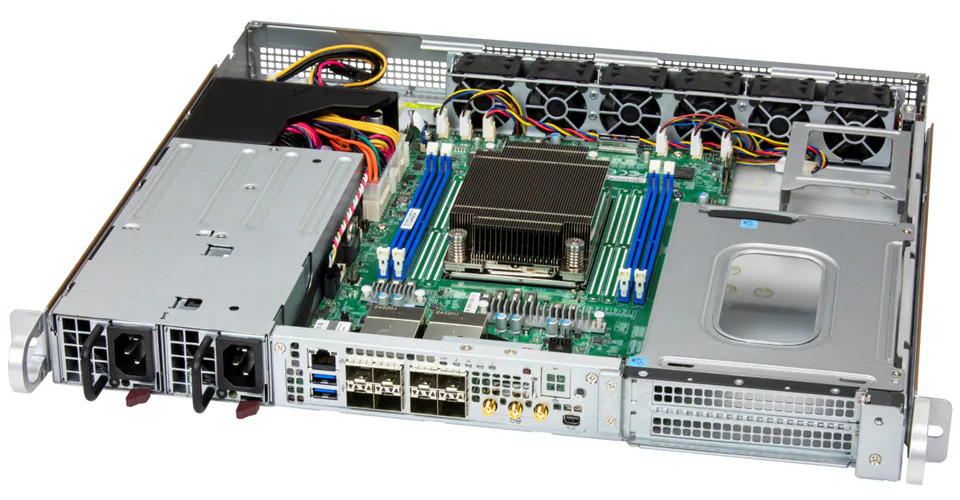
There is no externally accessible storage — no hot-swap bays, no caddies. Two fixed 2.5-inch U.2 NVMe drives live inside, which is the right trade for a machine deployed once and rarely opened. Four DIMM slots flank the SoC, and the space saved goes to two PCIe Gen5 x16 full-height slots, enough for a single-width accelerator if the site needs one.

Internal layout from above: the SoC in the centre, four DDR5 slots and two internal U.2 bays.
How the platform is wired
Everything below hangs directly off the processor. Note how little sits between the SoC and the network ports.
Intel Xeon 6 SoC 6716P-B
40 cores · 235 W · 160 MB cache
vRAN Boost · Speed Select
DDR5 memory
Up to 512 GB DDR5-6400 across four DIMM slots, one per channel.
25G PHY → 8 × SFP28
Intel E825-C on die, driving two quads of four lanes each.
Up to 2 × PCIe Gen5 x16
Full height, with room for one single-width accelerator card.
NVMe storage
Two internal 2.5-inch U.2 bays, with no externally accessible drives.
AST2600 BMC
IPMI 2.0 with KVM on RJ45 and SFP28, plus mini DisplayPort output.
Timing subsystem
GNSS module and OCXO feeding the SMA GNSS, 1PPS in and 1PPS out ports.
Networking and FEC come from the processor, not from a slot.

The X14SDW-40C-SP9F board underneath: SoC in the centre, four DIMM slots, and the three SMA timing connectors along the bottom edge.
GNSS timing and why telecom needs it
Three SMA connectors on the front panel are the clearest signal of who this machine was designed for. Radio access networks require nodes to agree on time to within microseconds, and that discipline has to come from somewhere — a GNSS receiver with a holdover oscillator, distributing 1PPS and 10 MHz references into the platform.
The detail worth noticing is that the three ports are not interchangeable: one takes the GNSS antenna, one accepts a 1PPS input, and one emits 1PPS. That last one matters. The server is not only a consumer of time — it can act as the timing source for other equipment in the same cabinet, which is exactly what a site needs when the radio units around it must share a clock. Combined with vRAN Boost in the processor, the two things that make a server usable as a distributed unit are both built in rather than bolted on.
Where it gets deployed
Supermicro positions this platform for six workloads, and the hardware choices map onto them directly.
Multi-Access Edge Computing
Compute placed inside the operator network, close to subscribers, where latency budgets rule out a round trip to a central site.
Telco edge
Aggregation and services in cabinets that were never sized for data-center equipment — the case the 399 mm depth exists for.
5G distributed unit
The DU workload that needs both FEC acceleration and disciplined timing, which is exactly what vRAN Boost and the GNSS module provide.
Satellite communication
Ground-segment processing where precise time references and high port counts matter more than raw core count.
vRAN / Open RAN
Virtualised radio access built on open interfaces, where the platform must terminate many high-speed links per node.
Edge AI
Inference alongside network functions, using the free PCIe slot for a single-width accelerator when the workload calls for it.
Configuration examples
The same chassis serves very different roles depending on how it is specified. These are starting points rather than fixed bundles — the exact components come from the configurator and from what your sites actually need.
MEC node
Mid memory footprint for tenant workloads, both NVMe bays populated for local persistence, a handful of the 25GbE ports terminated, PCIe slots left empty. Timing optional.
5G distributed unit
vRAN Boost carrying the FEC load, GNSS antenna plus 1PPS in and out wired, most or all eight 25GbE ports in use for fronthaul and midhaul, dry contact tied to the cabinet alarm loop.
Satellite ground segment
Timing prioritised — GNSS with holdover and 1PPS distribution to neighbouring equipment — with high port count for modem and baseband traffic and modest local storage.
Edge AI inference
Maximum memory for model residency, one single-width accelerator in a PCIe slot, both NVMe bays for model and data staging, fewer network ports terminated.
Planning a vRAN or MEC rollout?
Tell us which of these shapes matches your project and how many sites it covers. We will return a confirmed configuration and an EU delivery estimate.
Specifications at a glance
40
Cores, Intel Xeon 6716P-B
8 × 25G
SFP28 ports on the SoC
399 mm
Chassis depth, 1U
512 GB
Max DDR5-6400, four DIMMs
| Specification | Supermicro SYS-112D-40C-FN8P |
|---|---|
| Processor | Intel Xeon 6 SoC 6716P-B, 40 cores, 2.5 GHz base, 160 MB cache, 235 W TDP, with Intel Speed Select Technology and Intel vRAN Boost |
| Integrated board | Supermicro X14SDW-40C-SP9F |
| Memory | Up to 512 GB DDR5-6400 across four DIMM slots (1DPC) |
| Networking | 8 × SFP28 25GbE ports via Intel E825-C integrated in the SoC |
| Management | Shared IPMI on RJ45 and on SFP28, ASPEED AST2600 BMC, IPMI 2.0 with KVM |
| Expansion | Up to 2 × PCIe Gen5 x16 full-height slots, supporting one single-width GPU accelerator |
| Storage | Up to two internal 2.5-inch U.2 NVMe bays — no externally accessible drives |
| Timing | GNSS module with OCXO holdover; SMA connectors for GNSS antenna, 1PPS input and 1PPS output |
| Site signalling | Dry contact RJ45 port for cabinet alarm circuits |
| Local console | Mini DisplayPort output, two USB ports, power button and status LEDs on the front panel |
| Power | Two redundant 800 W Platinum power supplies, front-mounted |
| Form factor | 1U rackmount, 399 mm (15.7 in) depth, front I/O with rear exhaust |
How it compares to the alternatives
Most edge projects come down to a choice between four shapes of hardware. This is where each one wins and where it stops making sense.
| Option | Best for | Main advantage | Main limitation | Our recommendation |
|---|---|---|---|---|
| Fanless edge box | Local control, light inference, DIN-rail use | Small, rugged, low power | Limited compute, networking and expansion | Use when the local workload is light |
| SYS-112D-40C-FN8P | Telco edge, vRAN, MEC, satellite, compact edge AI | 40 cores, 8 × 25GbE, vRAN Boost, timing, 399 mm depth | Not storage-led or GPU-heavy | Recommended for short-depth telecom rollouts |
| Standard 1U/2U rack server | Data centers and central sites | Higher expandability, more storage options | Deeper chassis, rear access, add-in NICs likely needed | Use when cabinet depth and rear access are available |
| Dual-socket platform | Core-heavy virtualization and centralized compute | More cores and memory per node | More power, depth and integration complexity | Use when density matters more than edge fit |
Deployment checklist for telecom cabinets
Work through these before the first unit ships. Every one of them has caused a re-visit on someone's rollout.
Check the site, not just the spec sheet
- Cabinet depth — interior clearance, not the nominal size, and whether rear access exists at all.
- Airflow — where the exhaust goes, and whether a back-to-back layout has a path for the heat.
- Cable clearance — front bend radius for eight fibre runs plus power, management and antenna leads.
- Power feed — capacity and whether both supplies land on independent circuits.
- Timing — antenna route and sky view for GNSS, and which equipment consumes the 1PPS output.
- Port mapping — how many of the eight 25GbE ports each site terminates, and to what.
- Remote management — whether IPMI runs on copper or fibre at that site, and how the dry contact ties into the alarm loop.
When this is the wrong server
The design that makes it right for a telecom cabinet makes it wrong elsewhere.
- You need capacity storage. Two internal NVMe bays and no external access. For anything storage-led, look at a standard rackmount instead.
- You are deploying in a normal data center. With deep racks and rear access, you are paying for short depth and front I/O you will never use.
- Your workload is GPU-bound. One single-width accelerator in 1U is the ceiling — beyond that it is GPU server territory.
- You need more than 40 cores or more than 512 GB per node. A Xeon 6 SoC is single-socket by definition; dual-socket platforms scale past this comfortably.
- Timing, port count and FEC are irrelevant. Without those, a conventional single-socket server with one dual-port NIC does the same job for less.
How SERVER SIMPLY helps you deploy
Edge rollouts are rarely one server — they are the same configuration repeated across dozens of sites, each with its own cabinet depth, power feed and network handoff. SERVER SIMPLY works with you to design a solution that matches your technical requirements, drawing on the SYS-112D-40C-FN8P and the rest of the embedded and edge server range, and confirms delivery and lead times for the whole rollout rather than a single unit. If part of the deployment runs edge AI on fanless hardware or needs central GPU capacity, we scope those together rather than in isolation.
What to send us for a multi-site edge rollout configuration
- Number of sites and units per site
- Cabinet depth and whether rear access exists
- Required port count and 25GbE topology
- Whether GNSS timing, 1PPS in/out and vRAN acceleration are required
- Memory footprint per node
- NVMe requirements and whether internal fixed storage is acceptable
- Planned PCIe cards or accelerators
- Power feed and redundancy requirements
- Rollout country, schedule and required lead time
Validate your edge-site configuration
Send the checklist above and we will return a matched SYS-112D specification, EU pricing and a confirmed lead time for the whole rollout.
Sources
Configure the SYS-112D-40C-FN8P
Specify memory, NVMe, expansion cards and warranty on the product page, with live pricing.
Open the configuratorBrowse embedded & edge servers
The full short-depth, fanless and DIN-rail range, including the 36-core and 20-core SYS-112D variants.
Browse the rangeIntel-powered edge AI systems
Where fanless inference platforms fit alongside a server like this one.
Read the edge AI guideHow to use the configurator
A step-by-step walkthrough of building and pricing a system on any product page.
Read the guideFAQ
What is the Supermicro SYS-112D-40C-FN8P?
A 1U compact telco edge server built on the Intel Xeon 6 SoC, with a 40-core Xeon 6716P-B, eight 25GbE SFP28 ports integrated into the processor, vRAN Boost acceleration, front-facing I/O and GNSS timing — designed for telecom, satellite and edge sites rather than data centers.
Why does it have eight network ports without a NIC card?
The Intel Ethernet E825-C controller is built into the Xeon 6 SoC package, so the SFP28 cages are driven straight from the processor. Both PCIe Gen5 slots stay free for other cards.
What is Intel vRAN Boost and why does it matter here?
It is forward error correction acceleration integrated into the SoC. In a conventional build that function needs a dedicated accelerator card, so having it on the processor removes another component, another slot and another failure point from every node.
How deep is the chassis, and what cabinets does it fit?
399 mm, or 15.7 inches. That fits shallow telecom racks, ruggedised wall-mounted enclosures and standard cabinets — and allows two units to be mounted back to back in a standard-depth cabinet.
Can I really mount two of them back to back?
Two 399 mm chassis occupy under 800 mm together, so they fit within a standard-depth cabinet, and front I/O means each is serviced from its own side. The catch is airflow: mounted rear-to-rear their exhausts face each other, so the cabinet needs a central chimney or vented mid-panel to carry the heat away.
Why is all the I/O on the front?
Many edge racks are mounted against a wall or in enclosures that can only be opened from one side. Putting power, network, management and timing on the front means the machine can be installed and serviced without rear access.
How much memory does it take?
Up to 512 GB of DDR5-6400 across four DIMM slots in a one-DIMM-per-channel configuration.
Does it have hot-swap drive bays?
No. Storage is up to two internal 2.5-inch U.2 NVMe drives with no externally accessible bays — a deliberate trade for depth and front-panel space.
What are the three SMA connectors for?
They are not interchangeable: one takes the GNSS antenna, one accepts a 1PPS input and one outputs 1PPS. The output means the server can act as a timing source for other equipment in the same cabinet, not only consume a reference.
What is the dry contact port?
An RJ45 port that wires the server into the cabinet's alarm circuit — door sensors, temperature, power failure — the way traditional telecom equipment reports site conditions.
Can it be managed over fibre instead of copper?
Yes. IPMI is shared on both an RJ45 port and an SFP28 port, so a site running only fibre does not need a separate copper drop just for management.
Can it take an accelerator card?
Yes, within 1U limits. There are up to two PCIe Gen5 x16 full-height slots with support for one single-width GPU accelerator — enough for a compact accelerator or offload device, not for a data-center GPU.
How does it compare to a standard 1U rack server?
It gives up depth, external drive bays and dual-socket scaling. In exchange it fits cabinets a normal server cannot, needs no rear access, and delivers eight 25GbE ports plus FEC acceleration and carrier timing without consuming an expansion slot.
Are there other core counts in this family?
Yes. The SYS-112D line includes lower-core variants such as the 36-core and 20-core models, which trade compute for cost and power in the same short-depth chassis.
Can SERVER SIMPLY supply this server in Europe?
Yes. We help design a configuration around your technical requirements, covering the SYS-112D-40C-FN8P and its siblings, and provide EU pricing, delivery estimates and confirmed lead times on quote.
Related Products

Comment(s)