We use cookies to make your experience better. To comply with the new e-Privacy directive, we need to ask for your consent to set the cookies. Learn more.

Comparing JBOD and JBOF: Benefits and Use Cases
Posted:
June 13, 2024
Categories:
General Topics and News
Comparing JBOD and JBOF: Benefits and Use Cases
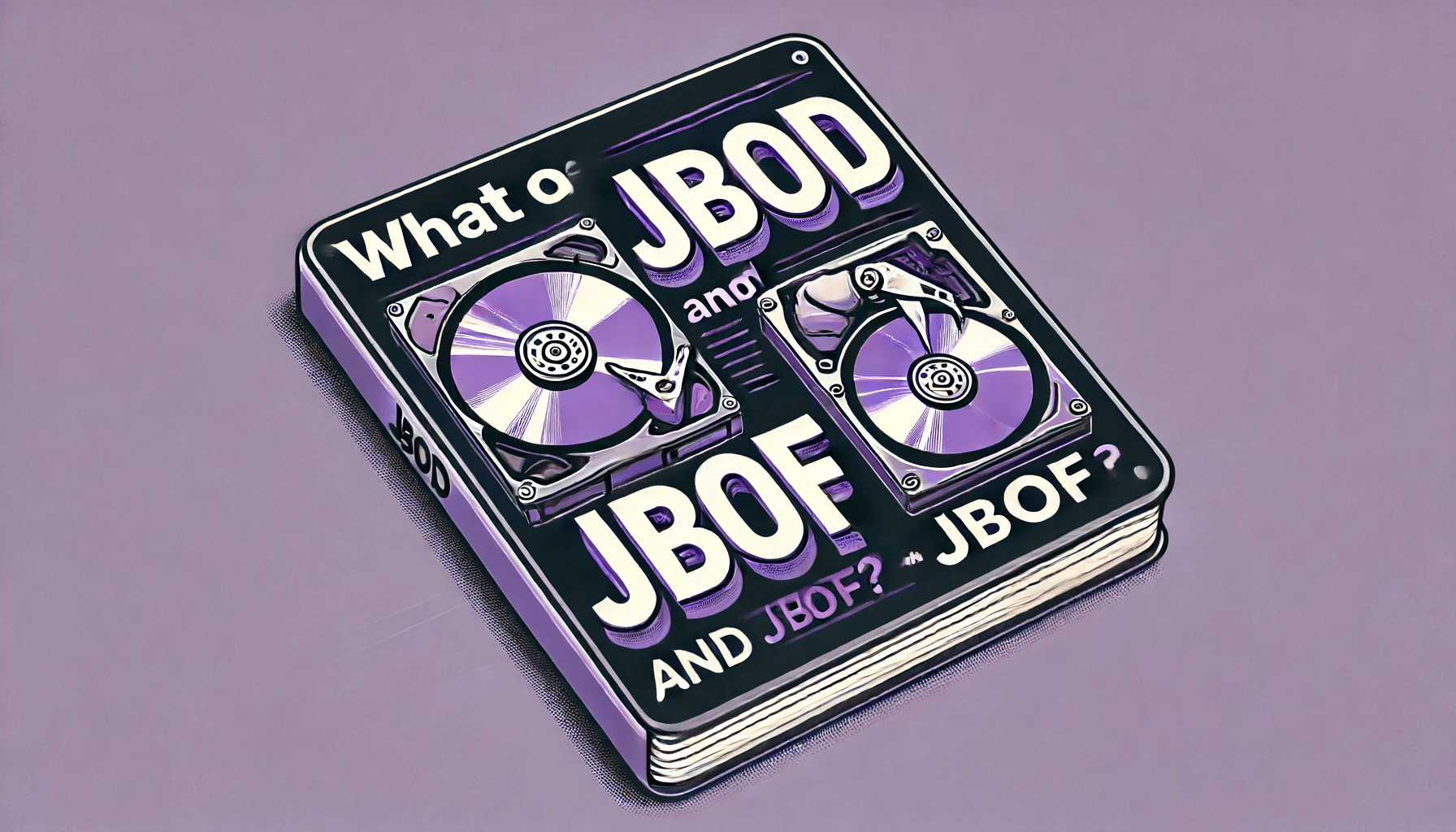
In the world of data storage, JBOD (Just a Bunch Of Disks) and JBOF (Just a Bunch Of Flash) are two crucial concepts in modern infrastructure. As data generation continues to grow exponentially, organizations require efficient and scalable storage solutions. JBOD and JBOF offer distinct approaches to handling large volumes of data, each with its own set of characteristics, advantages, and use cases.
Discover more about our custom servers that can be specifically tailored to your organization's unique needs and performance requirements. At Server Simply, we offer a range of JBOD solutions tailored to meet your storage needs.
What is JBOD (Just a Bunch Of Disks)
JBOD, an acronym for "Just a Bunch Of Disks," refers to a storage configuration where multiple hard drives are combined into a single physical storage unit. While JBOD can be used without RAID (Redundant Array of Independent Disks) technology, it is most commonly utilized in conjunction with Software RAID or Software-Defined Storage (SDS). In a JBOD setup, each disk operates independently, allowing data to be stored across several drives.
The concept of RAID (Redundant Array of Independent Disks) involves using multiple hard drives together to improve data storage. By spreading data across several disks, RAID provides better performance and ensures that data isn't lost if one drive fails. Different RAID configurations offer various benefits:
- RAID 0 (striping): Splits data across multiple disks to increase speed, but doesn't provide data protection.
- RAID 1 (mirroring): Duplicates data on two disks, so if one fails, the data is safe.
- RAID 5 (parity): Distributes data and parity information across multiple disks, balancing speed and data protection.
JBOD is often used with Software RAID or SDS, where data redundancy is managed through software solutions rather than relying on hardware-based disk redundancy. This approach provides data redundancy and performance enhancements through techniques such as striping, mirroring, and parity, which are managed at the software level.
The primary advantage of JBOD when used with RAID is its simplicity and cost-effectiveness. By avoiding the complexity and overhead associated with hardware RAID controllers, JBOD configurations with software RAID can be easily implemented and managed. This makes JBOD an attractive option for applications where flexible storage expansion and data protection are critical. Examples include small business servers, backup systems, and various types of data archiving.
In a JBOD array, the drives are usually managed by the operating system or storage controller, which treats the combined disks as individual storage volumes. When combined with software RAID, these volumes benefit from increased data protection and performance enhancements, making JBOD a practical and scalable solution for various use cases.
Physical Components:
- Hard Drives: JBOD arrays consist of multiple hard drives housed within a single chassis or connected to a storage controller. These drives can vary in capacity and type (e.g., SATA, SAS). When combined with RAID, these drives work together to provide data redundancy and performance enhancements.
- Enclosures: The physical enclosure for JBOD can range from simple desktop cases to large rack-mounted systems, depending on the scale and application. These enclosures are designed to house multiple drives and provide necessary cooling and power.
- Storage Controller: A storage controller or host bus adapter (HBA) manages the communication between the hard drives and the system's operating system. While it does not perform RAID functions itself, it works in conjunction with software RAID solutions to manage the drives and ensure data redundancy and performance.
Logical Organization:
- Independent Drives: Each disk in a JBOD configuration operates independently. However, when used with software RAID, data is written across multiple disks using techniques such as striping, mirroring, or parity to enhance data redundancy and performance.
- Volume Management: The operating system or storage management software typically handles the organization of disks into logical volumes. With RAID, multiple disks are combined into a single logical volume, which can include disk spanning, striping, or mirroring, increasing both storage capacity and data protection.
Data Management:
- Redundant: When JBOD is used with software RAID, it provides data redundancy. This means that if one disk fails, data can be recovered from other disks in the array, ensuring data integrity and minimizing the risk of data loss.
- Flexibility: Adding or removing disks in a JBOD array with RAID is relatively simple, providing flexibility in scaling storage capacity according to needs. The RAID configuration dynamically adjusts to include new disks or remove failed ones, maintaining data protection and performance.
What is JBOF (Just a Bunch Of Flash)
JBOF stands for "Just a Bunch Of Flash" and represents a similar concept to JBOD but utilizes flash memory instead of traditional spinning hard drives. Flash storage, known for its speed, reliability, and low latency, has become increasingly important in modern data storage solutions. In a JBOF configuration, multiple flash drives are grouped together to form a single storage system. This setup leverages the inherent advantages of flash memory, such as rapid data access, high throughput, and durability. JBOF systems are often used with Software RAID to provide data redundancy and performance enhancements, ensuring that data is mirrored and striped across multiple drives to prevent data loss in case of a drive failure.
The primary benefit of JBOF is its ability to deliver exceptional performance and reliability compared to traditional hard drive-based storage systems. With the decline in the cost of flash memory, JBOF has become a viable option for a wider range of applications, offering a balance between performance and cost. Both JBOD and JBOF provide valuable solutions for different storage needs. Understanding the distinctions between these two configurations is essential for selecting the appropriate technology based on specific requirements and workloads.
Physical Components:
- Flash Drives: JBOF arrays consist of multiple flash drives (e.g., SSDs) that provide high-speed, low-latency storage. These drives can be of various types, including NVMe, SAS, or SATA SSDs.
- Enclosures: Similar to JBOD, JBOF enclosures can range from compact desktop units to large rack-mounted systems designed for data centers. These enclosures often include advanced cooling and power management to support the high performance of flash drives.
- Flash Controllers: JBOF systems use specialized flash controllers that optimize data management and access speeds, ensuring efficient operation of the flash memory.
Logical Organization:
- Independent Flash Modules: Each flash drive in a JBOF system operates independently, similar to the drives in a JBOD array. However, due to the nature of flash memory, these systems often include features to enhance performance and endurance.
- Advanced Volume Management: JBOF systems may incorporate advanced storage management techniques, such as wear leveling and garbage collection, to extend the lifespan of flash drives and maintain high performance.
Data Management:
- Non-Redundant by Default: Like JBOD, JBOF does not inherently provide redundancy. However, many JBOF implementations support software-based redundancy solutions or integration with RAID controllers to offer data protection.
- High Performance: JBOF systems are designed to exploit the full potential of flash storage, offering significantly higher read/write speeds and lower latency compared to traditional hard drives. This makes JBOF ideal for applications requiring fast data access and processing.
Advantages and Disadvantages of JBOD
One of the primary advantages of JBOD (Just a Bunch Of Disks) is its simplicity. JBOD configurations are straightforward to set up and manage, as they do not involve complex algorithms or configurations. This simplicity also translates into cost-effectiveness, since JBOD does not require specialized RAID controllers, making it generally less expensive to implement.
Another significant benefit of JBOD is its flexibility. It is easy to add or remove drives from a JBOD setup, allowing for scalable storage expansion as needed. Additionally, JBOD allows for the full use of each drive's capacity without any overhead for redundancy or parity when used without RAID. This makes JBOD particularly attractive for applications where straightforward storage expansion and flexibility are needed.
When combined with Software RAID, JBOD provides enhanced data protection and performance. In this configuration, data is mirrored and striped across multiple drives, ensuring that physical disk failure does not result in data loss. This addresses one of the key drawbacks of traditional JBOD setups, which do not provide data redundancy on their own.
Advantages and Disadvantages of JBOF
JBOF (Just a Bunch Of Flash) offers several notable advantages, particularly in terms of performance and reliability. Flash storage provides significantly faster read/write speeds and lower latency compared to traditional hard drives, making JBOF ideal for high-performance applications. This enhanced performance is crucial for tasks requiring rapid data access and processing. Additionally, flash drives are generally more reliable and have a longer lifespan compared to spinning disks, reducing the likelihood of hardware failures.
Energy efficiency is another key advantage of JBOF. Flash storage consumes less power and generates less heat compared to traditional hard drives, which can lead to lower operational costs in data centers. The absence of moving parts in flash drives also contributes to their durability, making them less susceptible to physical damage and more robust in various environments.
However, JBOF systems also benefit greatly from the use of Software RAID, which provides data redundancy and enhances data protection. By distributing data across multiple drives with mirroring and striping, JBOF setups ensure that data loss is minimized in the event of a drive failure.
The primary drawback of JBOF is the cost; flash storage is generally more expensive than traditional hard drives, although the price gap has been narrowing over time. Another concern is the limited write endurance of flash memory. Flash drives have a finite number of write cycles, which can be an issue for applications with high write volumes. While advanced wear leveling and other techniques can mitigate this issue, they do not eliminate it entirely.
Comment(s)