We use cookies to make your experience better. To comply with the new e-Privacy directive, we need to ask for your consent to set the cookies. Learn more.

Supermicro Edge AI Systems: Fanless Inference with Intel Core Ultra and Arc Pro
Posted:
July 09, 2026
Categories:
General Topics and News
Supermicro Edge AI
Up to 180 TOPS
Intel Core Ultra Series 3
Arc Pro B50 / B60 / B70
EU configuration & lead time
Supermicro Edge AI Systems for Intel Core Ultra and Arc Pro GPUs: Which Platform Fits Your Deployment?
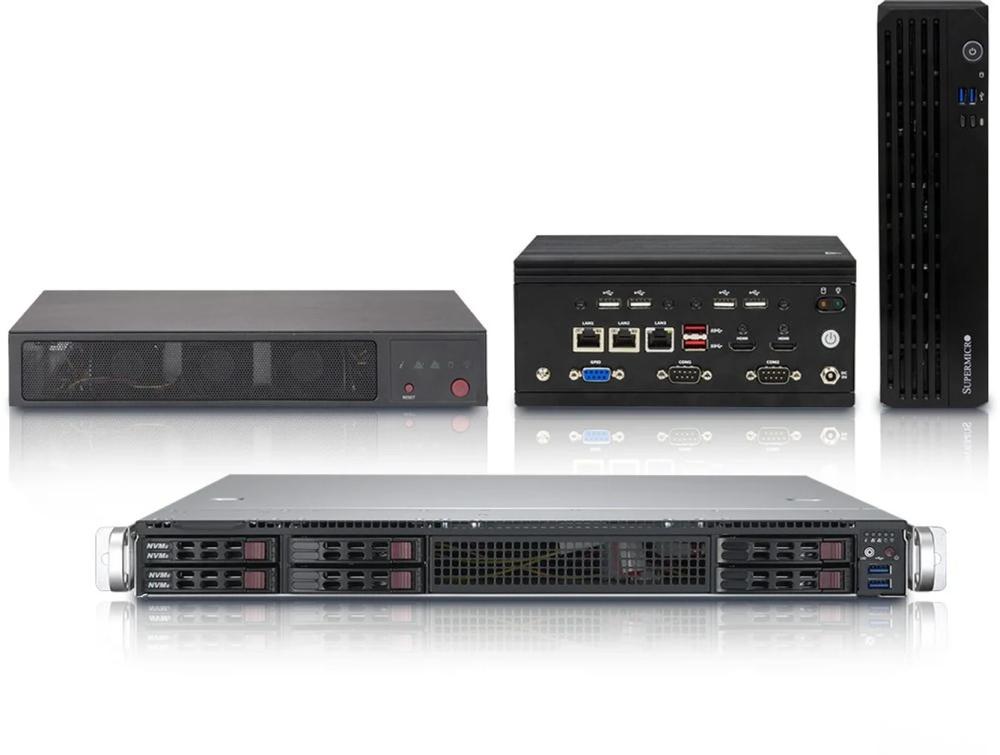
Compare Supermicro SYS-E103-14P, SYS-521AD-LN2, SYS-111AD-WN2R and SYS-E300-13AD5 edge AI systems with Intel Core Ultra, Intel Core Series 2 and Intel Arc Pro GPU options. This buyer guide explains which platform fits computer vision, automation, local inference and European deployment, and when to request a Supermicro edge AI quote from SERVER SIMPLY.
Short answer
Supermicro's edge refresh centers on the fanless SYS-E103-14P for rugged industrial inference, the SYS-521AD-LN2 AI mini tower for local AI development and discrete GPU acceleration, and refreshed short-depth platforms for constrained rack or compact edge locations. SERVER SIMPLY helps European teams configure, source and deploy these systems with clear lead-time checks, EU delivery options and an upgrade path from edge nodes to central GPU infrastructure.
Why this matters for infrastructure buyers
Cloud inference can be too slow, too bandwidth-heavy or too expensive for continuous camera and sensor data. Industrial sites may also need fanless hardware, rugged mounting, reliable local processing and a realistic GPU choice before ordering. The decision is not only about TOPS, but about workload, site conditions, power budget, mounting, supply, support and how the edge deployment later connects into rack-scale AI infrastructure.
What it is
A practical decision guide for choosing Supermicro edge AI systems, Intel Arc Pro edge AI GPU options and the right edge-to-core architecture.
Who should read this
European teams planning computer vision, automation, retail analytics, smart buildings, logistics, healthcare edge inference or distributed local AI processing.
Get an Edge AI Configuration and Lead Time
SERVER SIMPLY can validate your workload, recommend the right Supermicro edge AI system, check SYS-E103-14P lead time and confirm EU delivery options.
On this page
12-minute read- Why AI is moving to the edge
- Who this article is for
- Which Supermicro edge AI system fits
- What's new in Supermicro's edge portfolio
- The four systems at a glance
- Inside the SYS-E103-14P: fanless edge AI
- SYS-521AD-LN2: the AI mini tower
- Refreshed systems: WN2R and E300-13AD5
- Arc Pro B50 vs B60 vs B70 compared
- Edge system specs at a glance
- Edge AI vs central GPU infrastructure
- Performance: what Supermicro and Intel claim
- Industry use cases
- Before you deploy: a 5-point checklist
- How SERVER SIMPLY helps you deploy
- FAQ
Why AI is moving to the edge
Cameras, sensors and machines generate data continuously, and sending every frame or reading back to a central facility for processing adds latency, consumes bandwidth and creates a single point of failure. For workloads like computer vision, safety monitoring, robotics and industrial automation, decisions often need to happen in milliseconds, right where the data is captured — not after a round trip to a data center.
That's the gap edge AI hardware is built to close: systems designed to run inference locally, in environments a standard rack-mount server was never meant for — dusty control cabinets, unconditioned equipment rooms, vehicles, retail floors, branch offices. Supermicro's latest expansion of its Intel-powered edge lineup, alongside Intel's own Arc Pro GPU family, is aimed squarely at that shift.
For buyers, the core problem is practical: choose too little GPU headroom and the deployment stalls; choose the wrong form factor and the system may not fit the site; choose only for the first pilot and the edge layer may not connect cleanly into central infrastructure later. SERVER SIMPLY helps European teams validate these choices before ordering.
The buyer problem behind the hardware choice
- Cloud inference may be too slow or too expensive for continuous camera, video or sensor data.
- Industrial environments may need rugged, fanless edge AI systems that operate outside a traditional server room.
- Distributed locations often need reliable local inference even when connectivity is limited.
- The wrong GPU, power profile or form factor can create delays, thermal issues or installation problems.
- A small edge deployment may later need to become part of a wider edge-to-core AI architecture.
Who this article is for
This guide is written for teams comparing edge AI server configuration options, not just reading product news. It is most useful when you already have a workload, site type or procurement question and need to decide which Supermicro platform should be quoted.
Use this guide if you are
- Planning computer vision or sensor-based AI in factories, logistics sites, retail locations or smart buildings.
- Trying to run local inference without sending all data to the cloud.
- Comparing fanless edge systems, compact AI workstations and short-depth rack servers.
- Looking for a Supermicro edge AI supplier in Europe with configuration help, lead-time confirmation and procurement support.
- Planning edge AI nodes that may connect into larger central GPU or data center infrastructure later.
Which Supermicro edge AI system fits your deployment?
If you need a fast decision before going into specifications, start here. The right direction depends on the workload, physical environment, GPU requirement and whether this is a standalone edge project or part of a larger central AI infrastructure plan.
| Use case | Recommended direction | Why |
|---|---|---|
| Fanless industrial inference | SYS-E103-14P | Best fit for rugged or space-constrained edge environments where fanless operation, DIN-rail mounting and local inference matter. |
| Compact AI workstation or local development | SYS-521AD-LN2 | Better fit when discrete GPU support, local model development and flexible Intel Arc Pro or NVIDIA accelerator choices are needed. |
| Short-depth rack deployment | SYS-111AD-WN2R | Useful when the customer needs edge AI in a rack-constrained location, branch facility or compact equipment room. |
| Compact edge refresh | SYS-E300-13AD5 | Good option for teams already using compact edge systems and looking for a refreshed platform in a familiar footprint. |
| Large-scale training or high-throughput inference | GPU server or rack-scale infrastructure | Edge systems are not the right fit when the workload needs larger GPU memory pools, centralized compute or full rack-scale AI capacity. |
Request a Supermicro Edge AI Quote
Send your site count, workload, GPU preference and timeline, and SERVER SIMPLY will return a recommended system, accelerator direction, EU delivery estimate and lead-time confirmation.
What's new in Supermicro's edge portfolio
Supermicro has expanded and refreshed its Intel-based edge AI lineup with four systems: a new fanless industrial platform, a new AI mini tower, and two existing short-depth systems updated with newer processors and memory. Alongside the hardware, Supermicro is extending support for Intel's Arc Pro B-series GPUs across its edge portfolio, and tying the lineup back to its Data Center Building Block Solutions (DCBBS) program — the same validated building-block approach Supermicro uses to scale from a single server up to full rack and data-center deployments.
Supermicro's leadership has framed the update around the growth of agentic AI: as more organizations deploy autonomous, decision-making AI systems, they need edge infrastructure that delivers real-time inferencing, low latency and power efficiency at the point where data is generated. Intel's edge computing leadership has made a similar point from its side, tying its Core Ultra processors and Arc Pro GPUs to Supermicro's edge-optimized systems as a way to help customers deploy AI faster across varied real-world environments, balancing performance, power efficiency and total cost of ownership.
Supermicro's official overview of the Intel-powered edge AI portfolio expansion.
The four systems at a glance
SYS-E103-14P
Fanless, DIN-rail mountable. Intel Core Ultra Series 3, up to 180 platform TOPS. Built for computer vision, safety monitoring and industrial AI inference hardware.
SYS-521AD-LN2
Slim AI mini tower. Intel Core Series 2, up to 12 P-cores. Built for local inference, model development, fine-tuning and compact GPU acceleration.
SYS-111AD-WN2R
Short-depth 1U server, refreshed with Intel Core Series 2 and DDR5. Built for constrained-footprint rack upgrades and edge locations.
SYS-E300-13AD5
Compact edge platform, refreshed with Intel Core Series 2 and DDR5. Built for existing compact deployments that need more compute in the same footprint.
Inside the SYS-E103-14P: fanless AI at the edge
The SYS-E103-14P is Supermicro's newest fanless, DIN-rail-mountable edge system, built around Intel's Core Ultra Series 3 processor family. Because it has no fan, it can run silently in places where noise or airflow are a problem — a factory floor, a retail back office, a vehicle cabin — and Supermicro rates it for operation from 0°C to 45°C, a wider range than typical office equipment.

The fanless SYS-E103-14P-H: silent, DIN-rail mountable, and rated for 0°C to 45°C operation.
The platform ships with a choice of three Core Ultra Series 3 processors, each aimed at a different point on the performance-and-power curve:
| Processor | Configuration | Best for |
|---|---|---|
| Core Ultra X7 Processor 368H | 16 cores, 12-core Xe3 iGPU | The flagship option, for heavy vision-based AI |
| Core Ultra 5 Processor 336H | Balanced 12-core configuration | High-efficiency edge analytics |
| Core Ultra 5 Processor 335 | Lower-power configuration | Consistent, low-power control operations |
Up to 50 NPU TOPS
The integrated NPU5 alone delivers up to 50 dedicated TOPS for low-latency, real-time inferencing tasks.
Up to 180 platform TOPS
Combined CPU, integrated GPU and NPU throughput across the whole platform, per Supermicro's specifications.
Up to 128GB DDR5
Ample memory headroom for computer vision, sensor fusion and multi-stream inference pipelines.
0°C to 45°C
Rated operating range for fanless, rugged deployment in industrial and unconditioned spaces.
Typical use cases include object detection, safety monitoring, quality assurance and inventory management — the kind of always-on, latency-sensitive vision workloads that don't tolerate a round trip to a central facility. For buyers comparing a fanless edge AI system for industrial inference, the SYS-E103-14P is the first platform to check.
SYS-521AD-LN2: the AI mini tower
Where the SYS-E103-14P is built for headless inference, the SYS-521AD-LN2 is aimed at the people sitting in front of the machine — engineers fine-tuning a model, or a small office running local inference without relying on the cloud. It's a slim AI mini tower powered by Intel's Core Series 2 processors, with up to 12 high-performance P-cores and up to 64GB of DDR5 memory.
What sets it apart from the fanless system is a discrete GPU slot: the SYS-521AD-LN2 supports compact accelerators including Intel's own Arc Pro B50 and NVIDIA's RTX PRO 2000 Blackwell — with a dual-GPU option for heavier local pipelines — so it can be configured for either an Intel- or NVIDIA-based inference and fine-tuning setup. Supermicro positions it for local AI inference, model development and fine-tuning in both office and edge environments — a middle ground between a fanless industrial box and a full data-center GPU server.
Refreshed systems: SYS-111AD-WN2R and SYS-E300-13AD5
Alongside the two new systems, Supermicro has refreshed two existing compact platforms — the short-depth 1U SYS-111AD-WN2R and the compact SYS-E300-13AD5 — with Intel's Core Series 2 processors and DDR5 memory. Both keep their existing physical footprint, so organizations that have already standardized on these form factors, in a comms closet or a short-depth rack, can gain more CPU and AI performance without re-planning the deployment.

The short-depth 1U SYS-111AD-WN2R: more compute in the same constrained footprint.
Arc Pro B50 vs B60 vs B70 compared
Supermicro's edge portfolio also gains support for Intel's full Arc Pro B-series lineup, giving edge systems a path to discrete GPU acceleration when integrated CPU graphics and NPUs aren't enough. For an Intel Arc Pro edge AI system, the main question is whether the workload is constrained by space and power, VRAM, multi-GPU scaling or high-throughput inference.
| GPU | Cores / XMX engines | VRAM | Bandwidth | TDP | Peak AI performance |
|---|---|---|---|---|---|
| Arc Pro B50 | 16 Xe2 cores / 128 XMX | 16GB GDDR6 | 224 GB/s | 70W | Up to 170 TOPS |
| Arc Pro B60 | 20 Xe2 cores / 160 XMX | 24GB GDDR6 | 456 GB/s | 120–200W | Up to 197 TOPS |
| Arc Pro B70 | 32 Xe2 cores / 256 XMX | 32GB GDDR6 | 608 GB/s | Up to 230W | Up to 367 TOPS |
The B50 is the option built into the SYS-521AD-LN2's compact accelerator support, aimed at space- and power-constrained deployments. The B60 supports multi-GPU scalability, with dual-GPU partner cards offering up to 48GB of combined VRAM. The B70 is Intel's flagship "Big Battlemage" card, launched in March 2026 with the largest VRAM pool in the lineup — positioned for higher-throughput inference pipelines and larger local models where memory capacity, not just raw compute, is the bottleneck.
TOPS figures are Intel's own stated peak INT8 (dense) figures; real-world performance depends on workload, precision format and software stack.
Compare Intel Arc Pro and NVIDIA GPU Options
Tell us your model size, software stack and power limits, and we can recommend whether Intel Arc Pro, NVIDIA RTX PRO or a central GPU server is the better route.
Edge system specs at a glance
| Spec | SYS-E103-14P | SYS-521AD-LN2 | SYS-111AD-WN2R / SYS-E300-13AD5 |
|---|---|---|---|
| Processor | Intel Core Ultra Series 3 (X7 368H / Ultra 5 336H / Ultra 5 335) | Intel Core Series 2 (up to 12 P-cores) | Intel Core Series 2 |
| Memory | Up to 128GB DDR5 | Up to 64GB DDR5 | DDR5 (refreshed) |
| GPU / accelerator | Integrated Xe3 iGPU + NPU5 (no discrete GPU required) | Intel Arc Pro B50 or NVIDIA RTX PRO 2000 Blackwell (dual-GPU option) | Existing accelerator options |
| AI performance | Up to 180 platform TOPS | Depends on accelerator (Arc Pro B50: up to 170 TOPS) | Improved vs. prior generation |
| Form factor | Fanless, DIN-rail mountable | Slim mini tower | Short-depth 1U / compact |
| Operating range | 0°C to 45°C | Standard office/edge range | Standard |
| Best for | Computer vision, safety monitoring, automation | Local inference, model development, fine-tuning | Upgrading existing compact deployments |
Edge AI vs central GPU infrastructure
Edge AI and central GPU infrastructure solve different problems. Edge systems are best when data must be processed close to the camera, sensor, machine or branch location. Central GPU servers and racks are better when the workload needs larger memory pools, model training, high-throughput batch inference or shared compute across many teams.
Choose edge AI when
The workload is latency-sensitive, bandwidth-heavy, site-specific or needs to keep data local. This is common in manufacturing inspection, retail monitoring, vehicle systems, access control and local automation.
Choose central GPU infrastructure when
The workload needs large GPU memory, multi-node scaling, centralized training, shared model serving or data-center reliability. In this case, edge devices may still collect data and send selected results back to the core.
When an edge AI system is not the right fit
These systems are purpose-built for inference and light fine-tuning at the edge. They are the wrong starting point in several common cases.
- You need to train or fine-tune large models at scale: edge systems handle inference and small-scale fine-tuning; large-scale training belongs on a data center GPU server or rack.
- Latency to a central facility isn't a real constraint: if round-trip time to an existing data center is acceptable, a standard rack-mount server may be more cost-effective than purpose-built edge hardware.
- Your workload needs more memory or GPU headroom: up to 128GB DDR5 (SYS-E103-14P) or a single Arc Pro B50/RTX PRO 2000 Blackwell (SYS-521AD-LN2) has real ceilings; larger models belong on a data center-class GPU server.
- Your environment doesn't need ruggedization: if you're deploying inside a climate-controlled server room rather than a factory floor, vehicle or retail site, a standard 1U/2U server is likely more cost-effective than fanless or DIN-rail hardware built for harsher conditions.
Plan Edge-to-Core AI Infrastructure
SERVER SIMPLY can help map the edge nodes, GPU servers, rack infrastructure and data-center building blocks needed for a deployment that grows beyond the first site.
Performance: what Supermicro and Intel claim
The figures below are Supermicro's and Intel's own stated, peak/representative claims and will vary in real deployments depending on workload, software and configuration — treat them as vendor claims pending independent benchmarks.
Up to 180 TOPS
Supermicro's stated combined CPU, iGPU and NPU throughput for the SYS-E103-14P platform.
Up to 367 TOPS
Intel's peak INT8 figure for the Arc Pro B70, the highest in the current Arc Pro B-series lineup.
Up to 50 NPU TOPS
The SYS-E103-14P's NPU5 alone, dedicated to low-latency tasks such as object detection.
0°C to 45°C
Supermicro's rated operating range for the fanless SYS-E103-14P, wider than standard office equipment.
Performance figures are vendor-stated; real-world results depend on workload, model precision and system configuration.
Industry use cases
Edge AI hardware becomes easier to specify when the deployment is tied to a concrete site and workflow. These examples show where a fanless edge node, compact AI workstation or short-depth edge server can fit.
Manufacturing quality control
Run local vision models for defect detection, line monitoring and safety events without sending every camera stream to the cloud.
Retail shelf monitoring
Process video locally for shelf availability, queue analytics, loss prevention and store operations while limiting bandwidth use.
Smart building security
Support local access control, occupancy analytics, anomaly detection and automation in buildings where latency matters.
Logistics gate automation
Use edge inference for license plate recognition, yard monitoring, package flow and automated checkpoints at distributed sites.
Healthcare edge inference
Keep selected AI workloads close to devices, rooms or departments where data locality, response time and reliability matter.
Transportation and vehicles
Deploy rugged or compact systems for onboard analytics, fleet monitoring, safety systems and mobile inference workloads.
Before you deploy: a 5-point checklist
Before committing to an edge AI platform, work through these five questions. They drive the system choice, the GPU option and whether this is a single-site pilot or part of a larger roll-out — and they are exactly what our team will ask on a scoping call.
Check these 5 things first
- How many edge locations do you need, and what's the physical environment (temperature, dust, vibration, available space, mounting and airflow)?
- What's your target latency, and does the workload genuinely need local inference rather than a round trip to a central facility?
- Which workload — computer vision and automation, or local model development and fine-tuning — determines whether a fanless system or a mini tower with a discrete GPU is the better fit?
- What are the power budget, GPU preference, software stack and expected model size for the edge AI server configuration?
- Are you buying for one site, refreshing compact edge hardware, or planning a larger edge-to-core rollout with GPU servers and rack infrastructure?
How SERVER SIMPLY helps you deploy
Choosing an edge AI system is rarely just a hardware decision. The right configuration depends on the inference workload, physical site conditions, latency requirements, GPU preference, power budget and whether the deployment later needs to connect into central GPU or rack-scale infrastructure. SERVER SIMPLY helps European customers validate these choices before ordering, so the system arrives configured for the real deployment environment — not only for the datasheet.
We help with configuration, sourcing, European supply, technical sales support, lead-time checks, warranty options and project-based procurement. That matters when the buyer needs to compare an edge AI server, an AI mini tower, a short-depth rack system and a central GPU server before committing budget.
Recommended system
We help decide whether SYS-E103-14P, SYS-521AD-LN2, SYS-111AD-WN2R, SYS-E300-13AD5 or a GPU server is the better starting point.
GPU recommendation
We compare Intel Arc Pro and NVIDIA GPU options against your model size, software stack, power envelope and future scaling plan.
EU delivery estimate
We confirm availability, lead time and delivery options for European buyers before the configuration is finalized.
Workload compatibility check
We review latency, memory, accelerator, thermal and deployment constraints so the quoted hardware matches the real site.
Upgrade path
We help connect edge nodes into GPU servers, rack infrastructure and data-center building block solutions as demand grows.
Procurement support
We support project-based purchasing, warranty planning, configuration documentation and quote preparation.
What to send us for a quote
To return a specific configuration and lead-time estimate, share: the number of edge sites and their physical environment; your target workload (computer vision, automation, or local fine-tuning); your GPU preference (Intel Arc Pro or NVIDIA); your power and mounting limits; and your timeline. If this connects to a larger central AI deployment, let us know so we can plan both together.
Get an edge AI infrastructure configuration
Tell us about your sites and workloads and we'll return a recommended system, GPU or accelerator direction, EU delivery plan, lead-time confirmation and upgrade path.
Sources
- What Supermicro's New Edge Systems Mean For Data Centres — Data Centre Magazine
- SYS-E103-14P-H — Official Supermicro Product Page
- Supermicro Brings Enterprise-Class AI Performance to the Client, Edge, and Consumer Markets — Supermicro Newsroom
- Supermicro's New Intel Edge AI Systems — StorageReview
- Intel Arc Pro B-Series Graphics Cards — Official Overview
- Supermicro Broadens AI at the Edge Solutions Portfolio with Intel-Powered Platforms — Official Video
Browse all GPU servers
The full SERVER SIMPLY catalog — NVIDIA and AMD GPU servers across PCIe, HGX and rack-scale form factors, for when workloads outgrow the edge.
Browse GPU serversConfigure a rack enclosure
Browse rack and enclosure options for scaling from edge nodes into rack-scale central infrastructure.
Configure racksAI SuperClusters from Supermicro
The turnkey, pre-validated rack-scale approach for the data-center side of an edge-to-core AI deployment.
See AI SuperClustersInside the Supermicro GB300 NVL72 rack
The current-generation 72-GPU rack for central AI training and inference at scale.
Explore GB300 NVL72FAQ
What's new in Supermicro's edge AI portfolio?
Supermicro has added the fanless SYS-E103-14P and the SYS-521AD-LN2 AI mini tower, refreshed the SYS-111AD-WN2R and SYS-E300-13AD5 with Intel Core Series 2 and DDR5, and expanded support for Intel's Arc Pro B50, B60 and B70 GPUs across its edge lineup.
What is the Supermicro SYS-E103-14P?
A compact, fanless, DIN-rail-mountable industrial system built on Intel's Core Ultra Series 3 processors, delivering up to 180 platform TOPS for computer vision, safety monitoring and automation, without needing a discrete GPU.
How many TOPS does the SYS-E103-14P deliver?
Up to 180 platform TOPS combined across the CPU, integrated Xe3 GPU and NPU5, with the NPU alone providing up to 50 dedicated TOPS for low-latency inferencing tasks.
What is the SYS-521AD-LN2 used for?
It's a slim AI mini tower designed for local AI inference, model development and fine-tuning in office and edge environments, powered by Intel Core Series 2 processors with up to 64GB of DDR5 memory.
Which GPUs does the SYS-521AD-LN2 support?
It supports compact discrete accelerators including Intel's Arc Pro B50 and NVIDIA's RTX PRO 2000 Blackwell, with a dual-GPU option — so it can be configured for either an Intel- or NVIDIA-based pipeline.
What changed with the SYS-111AD-WN2R and SYS-E300-13AD5?
Both were refreshed with Intel Core Series 2 processors and DDR5 memory, gaining more compute and AI performance while keeping their existing short-depth and compact physical footprints.
What are Intel's Arc Pro B50, B60 and B70 GPUs?
They are Intel's discrete workstation GPUs for edge and AI workloads: the B50 (16GB VRAM, up to 170 TOPS, 70W) is aimed at space-constrained deployments; the B60 (24GB VRAM, up to 197 TOPS) supports multi-GPU scaling; and the B70 (32GB VRAM, up to 367 TOPS) is Intel's flagship card for high-throughput inference.
Do these edge systems replace data center GPU servers?
No. They handle inference and light fine-tuning at the edge; large-scale model training and high-capacity inference still belong on data center GPU servers or racks.
What is Supermicro's DCBBS portfolio, and how does it relate to edge systems?
Data Center Building Block Solutions (DCBBS) is Supermicro's validated, modular approach to AI infrastructure, spanning individual servers up to full rack-scale and data center-level deployments. It gives edge deployments a defined path to scale into central infrastructure.
What operating conditions is the SYS-E103-14P rated for?
Supermicro rates the fanless SYS-E103-14P for operation from 0°C to 45°C, wider than typical office equipment, and it's DIN-rail mountable for installation in industrial control cabinets.
Can SERVER SIMPLY supply these Supermicro edge AI systems in Europe?
Yes. SERVER SIMPLY can configure the SYS-E103-14P, SYS-521AD-LN2 and related edge platforms with your choice of Intel Arc Pro or NVIDIA GPU options, and handle EU delivery, integration testing, lead-time checks and quote preparation.
What should I send to get a Supermicro edge AI quote?
Send the number of sites, physical environment, target workload, latency target, GPU preference, power or mounting constraints and deployment timeline. If the edge system connects to a central GPU server or rack later, include that plan too.
How does SERVER SIMPLY confirm lead time and EU delivery?
SERVER SIMPLY checks availability, configuration requirements and sourcing options before returning a quote, so buyers can understand expected lead time, delivery path and procurement steps before ordering.
What industries are these edge systems designed for?
Supermicro positions the lineup for retail, manufacturing, physical security, transportation and logistics, alongside broader industrial automation, healthcare edge inference, smart building and computer-vision use cases.
Related Products


Comment(s)