We use cookies to make your experience better. To comply with the new e-Privacy directive, we need to ask for your consent to set the cookies. Learn more.

Understanding Spine-Leaf Architecture: Revolutionizing Data Center Networks

Posted:
May 06, 2024
Categories:
General Topics and News
Understanding Spine-Leaf Architecture: Revolutionizing Data Center Networks
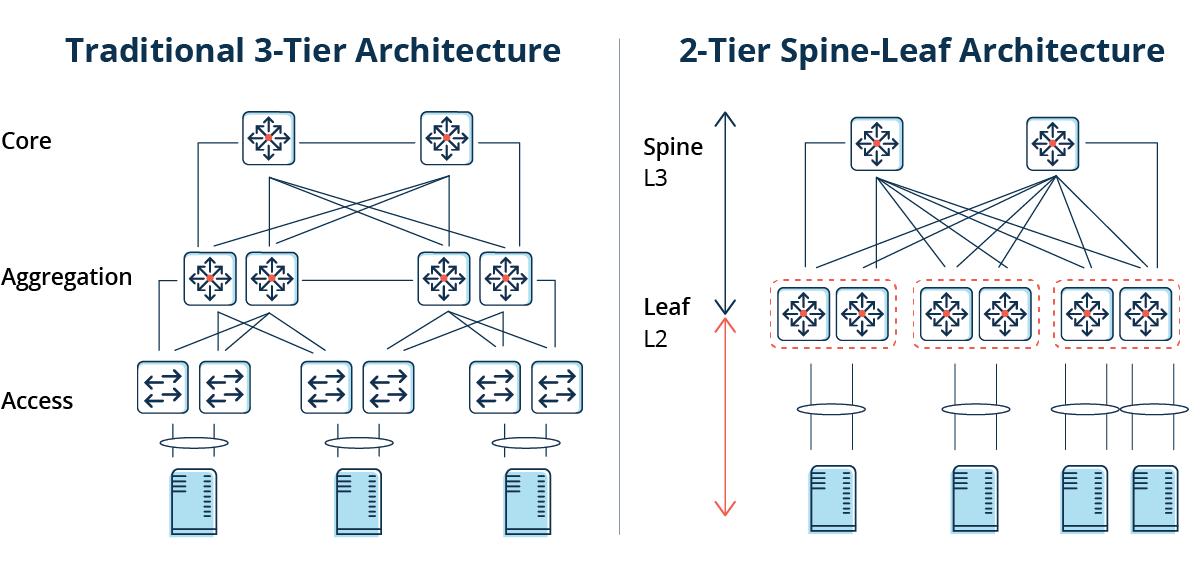
Spine-leaf architecture is a modern network topology that has revolutionized data center layouts by simplifying scalability and enhancing performance. At its core, this architecture consists of two distinct layers: the Spine (main switches) and the Leaf (access switches). Spine switches act as the backbone of the network, interconnecting all the leaf switches, which in turn connect directly to servers and other network endpoints. This design not only reduces latency but also increases flexibility in handling high volumes of data traffic, typical in environments where processing efficiency and speed are critical.
Technical Description of Components
The spine-leaf architecture is built upon two principal types of switches that define the efficiency and structure of the network: Spine switches and Leaf switches. The leaf layer consists of access switches that connect to servers and provide connections for end users. In such environments, like Server Simply’s range of custom servers are designed to meet specific performance requirements, ensuring optimal performance and scalability.
Spine Switches
Spine switches form the central part of the network, functioning as the backbone to which all leaf switches are connected. These switches are responsible for high-capacity data transmission across the network, ensuring that data packets travel efficiently from one leaf switch to another. The spine layer is crucial for maintaining the performance of the network as it scales, providing a robust framework that can handle increasing data demands without bottlenecks. For a deeper understanding of Datacenter Networking, refer to our detailed blog post.
Leaf Switches
Leaf switches, on the other hand, connect directly to network endpoints such as servers, storage systems, and sometimes directly to end-user devices. Each leaf switch connects to all spine switches, creating a large non-blocking fabric, thus increasing redundancy and reducing traffic bottlenecks. Their primary role is to aggregate traffic from these devices and forward it through the spine for routing to other parts of the network. Leaf switches are typically positioned closer to data sources and destinations, which minimizes latency and maximizes access speed, crucial for real-time applications and services. Explore our Workstations & Tower Servers category to find solutions tailored for such needs.
Interaction Between Layers and Data Routing Principles
In spine-leaf architecture, each leaf switch is interconnected with every spine switch, forming a non-blocking, full-mesh network. Every leaf switch in a spine-leaf architecture connects to every switch in the network fabric, contributing to reduced latency and bottlenecks as data packets only need to travel to a spine switch and another leaf switch to reach their endpoint. This setup eliminates the need for traditional hierarchical networking models and reduces the hop count between servers, significantly lowering latency.
Data routing within this topology is managed through protocols like Equal-Cost Multipath (ECMP), which allows for the distribution of traffic loads evenly across multiple pathways. ECMP enhances the overall efficiency of the network by preventing any single link from becoming a bottleneck, thus optimizing bandwidth utilization and ensuring resilience by providing alternate paths for data transmission in case of a link failure. To optimize your GPU server configurations, consider our advanced solutions tailored for high-performance networking.
This design ensures that traffic between any two endpoints in the network typically passes through only two switches—a leaf and a spine—regardless of the physical location of the endpoints within the data center. This consistency in path length is critical for maintaining predictable network performance and is a distinct advantage over traditional three-tier architectures, where path lengths can vary significantly, adding complexity and potential performance issues.
Differences from Traditional Network Architectures
The spine-leaf architecture marks a significant departure from the traditional three-tier network model commonly used in earlier data center designs. Understanding these differences can highlight why spine-leaf is becoming the preferred choice for modern data centers. Unlike the traditional three-tier architecture, which has distinct network layers, traffic patterns, and protocols, spine-leaf architecture offers improved redundancy, increased bandwidth, improved scalability, lower costs, low latency, and energy efficiency.
Comparison with the Traditional Three-Tier Model
Traditional data center networks were structured in three hierarchical layers: access, aggregation (or distribution), and core. The access layer connected servers to the network, the aggregation layer consolidated connections from multiple access switches and facilitated redundant connections, and the core layer was responsible for fast, high-capacity transport between aggregation switches and the rest of the network. This structure, while effective in smaller or less dynamic environments, often led to issues of latency, bottlenecks, and complexity in large-scale or high-growth scenarios. Port density is a critical factor in spine-leaf architecture, influencing the maximum number of leaf switches and the sizing of spine switches, which helps prevent network problems and enhances performance.
Key Changes in Spine-Leaf Architectures:
- Elimination of Spanning Tree Protocol (STP): In traditional architectures, STP was used to prevent network loops and provide path redundancy, which could lead to underutilization of available bandwidth as only one path would be active at a time. Spine-leaf architecture typically does away with STP, instead relying on protocols like ECMP to handle path redundancy and load balancing. This approach allows all paths to be active simultaneously, significantly increasing the effective bandwidth and reducing potential bottlenecks.
- Use of Fixed Port Switches Over Modular Models: Spine-leaf architectures often favor fixed port switches instead of the modular switches traditionally used in the core layer of three-tier designs. Fixed port switches generally provide greater predictability in performance and can be scaled out by adding more units, which aligns well with the scale-out nature of spine-leaf architectures. This scalability is vital for rapidly growing data centers that need to expand network capacity without major reconfigurations.
These architectural shifts not only simplify physical and logical designs but also enhance performance and scalability. By reducing the number of layers and eliminating outdated protocols, spine-leaf architectures provide a more straightforward, robust, and adaptable framework suitable for the dynamic demands of modern data centers, including cloud environments and big data applications. This setup ensures that as data center needs grow, the network can scale efficiently both in size and performance.
Advantages of Spine-Leaf Architecture
Spine-leaf architecture offers several compelling benefits that make it highly suited for contemporary data center needs, particularly as data volumes and network traffic patterns become more complex.
When considering leaf and spine sizing, it is crucial to evaluate the relationship between the number of leaf switches, port density of spine switches, required throughput, redundant paths, and port density to prevent network issues.
Performance Enhancement through Reduced Latency
One of the most significant advantages of the spine-leaf architecture is the reduction in latency. By design, the architecture ensures that every device is equidistant from each other, typically requiring only one switch hop to move from one server to another via a spine switch. This uniformity significantly reduces latency as data does not need to traverse multiple switches, which is often the case in traditional hierarchical models. For applications requiring high-speed data processing and transfer, such as financial trading platforms or real-time data analytics, this can lead to noticeable performance improvements.
Optimization of East-West Traffic
In traditional three-tier architectures, the north-south traffic (data that travels from the end-user or internet into the data center and back) was predominant. However, with the rise of distributed applications, virtualization, and cloud services, east-west traffic (data traveling laterally within the data center from server to server) has become much more prevalent. Spine-leaf architecture optimally supports this shift by facilitating faster and more efficient east-west data flows, which is essential for modern applications that operate across multiple servers and possibly even multiple data centers.
Scalability and Simplified Management
The scalability of spine-leaf architecture is another critical benefit. As network demands increase, new switches (both spine and leaf) can be added without significant reconfiguration of the existing network. This scalability is supported by technologies such as Equal-Cost Multipath (ECMP), which allows for multiple parallel paths between any two points in the network. ECMP distributes traffic evenly across all available paths, maximizing bandwidth utilization and preventing any single path from becoming a bottleneck. Moreover, this capability simplifies network management and reduces downtime, as paths can be added or removed without disrupting the network.
Additionally, the simplified cabling and reduced complexity of managing a spine-leaf setup as opposed to a multi-layered traditional model mean that IT departments can deploy infrastructure changes more quickly and with fewer errors. The physical layout of spine and leaf switches also tends to be more compact and easier to manage, which is beneficial in data centers where space can be at a premium.
These advantages collectively enhance the agility of a data center, enabling it to better respond to the dynamic needs of modern business environments, including rapid scalability, high reliability, and exceptional performance. This makes spine-leaf architecture an indispensable component of any forward-thinking data center strategy.
Conclusion
The spine-leaf architecture has emerged as a pivotal innovation in the design of modern data centers, reshaping how we think about network efficiency, scalability, and performance. This architecture simplifies complex traditional models and offers a more streamlined, robust solution capable of meeting the demanding requirements of contemporary digital operations.
As data center technologies continue to evolve, the spine-leaf architecture is likely to remain at the forefront, particularly as we move towards more decentralized and cloud-based environments. The architecture's ability to scale efficiently and manage large volumes of data seamlessly makes it ideally suited to the future of big data and IoT (Internet of Things), where data processing needs will only grow.
Additionally, innovations in network technology, such as the integration of AI and machine learning for network management and automation, will further enhance the capabilities of spine-leaf architectures. These technologies can predict traffic patterns and automatically adjust network configurations to optimize performance and reliability without human intervention.
The spine-leaf architecture not only meets the current demands of modern data centers but is also poised to adapt to future changes, making it a sustainable and strategic choice for organizations looking to build resilient, future-proof network infrastructures. As such, it represents not just a technological choice but a strategic business decision that can define the competitiveness and innovation capacity of enterprises in the digital age.
Related Products

0 Comment(s)