We use cookies to make your experience better. To comply with the new e-Privacy directive, we need to ask for your consent to set the cookies. Learn more.

Powering LLMs: Infrastructure Essentials

Posted:
June 19, 2025
Categories:
General Topics and News
Powering LLMs: Infrastructure Essentials

LLM infrastructure is the foundational framework and resources required to develop, deploy, and maintain large language models. These AI systems, like ChatGPT, can understand, generate, and manipulate human language and data, making it possible for machines to respond in natural, meaningful ways. LLM infrastructure powers chatbots, content creation, translation, diagnostics, financial modeling, and personalized education—offering scalable, efficient, flexible, reliable, cost-effective, and secure AI systems.
Need to know. Language models are machine learning systems trained to understand and generate human language. They learn the statistical patterns of word sequences—effectively estimating how likely a specific word (or token) follows in a given context—to produce coherent and contextually appropriate text.
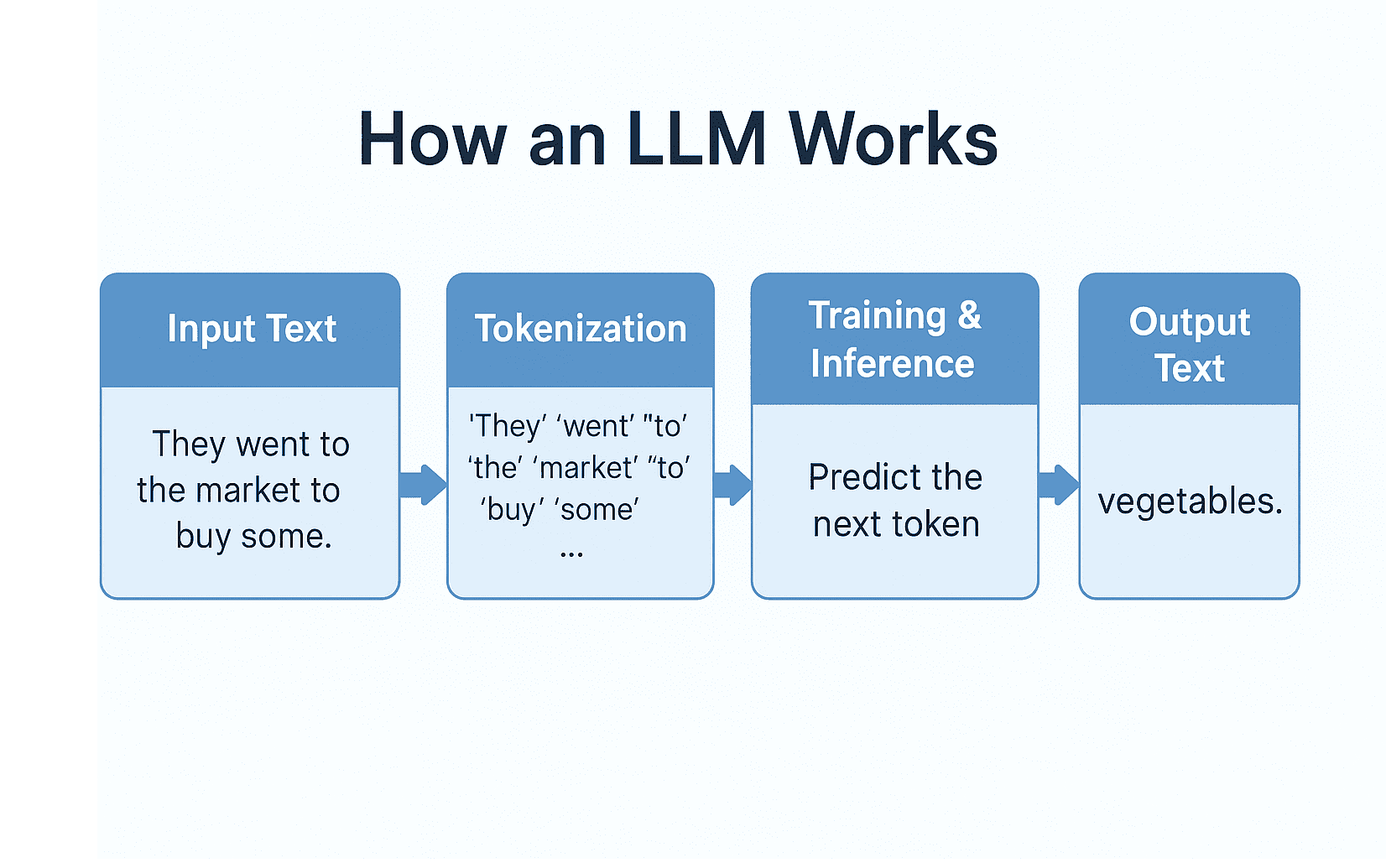
Figure: This image illustrates the basic workflow of a large language model (LLM): it starts with input text, which is then broken down into smaller units called tokens in a process known as tokenization. The model analyzes these tokens, predicts what should come next based on patterns it has learned during training, and finally generates coherent output text. Tokenization is the process of splitting text into words or subwords (tokens), making it possible for the model to process and understand language in manageable pieces.
Components of LLM Infrastructure
- Hardware: High-performance HPC systems, GPUs, TPUs, and specialized AI accelerators are essential due to the intensive computational and parallel demands.
- Software: Frameworks and libraries such as TensorFlow, PyTorch, and custom-built solutions enable model training, deployment, and inference.
- Data Storage: Scalable storage systems with high-speed access manage the large datasets needed for training LLMs.
- Networking: High-bandwidth, low-latency networks are critical for communication between infrastructure components, especially in distributed settings.
- Data Management: Tools for preprocessing, annotation, and versioning ensure data quality and reproducibility.
- Security: Measures such as encryption, access controls, and secure data transfer maintain data privacy and model integrity.
LLM infrastructure underlies applications such as chatbots, virtual assistants, content generation, real-time translation, healthcare diagnostics, financial analysis, and personalized education systems.
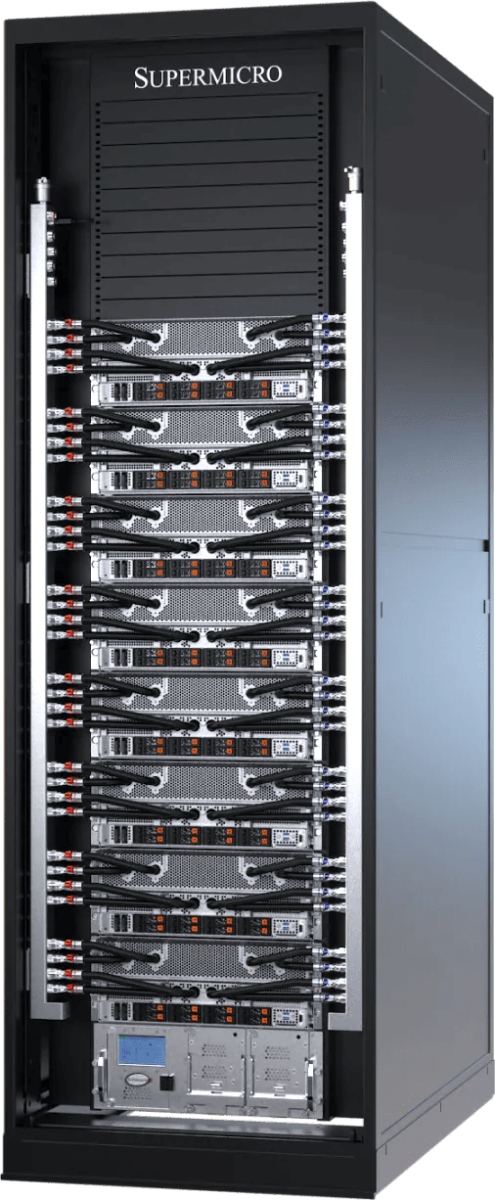
Spotlight: Supermicro’s LLM Infrastructure Strategy
Supermicro offers a full‑stack approach specifically engineered for LLM workloads, featuring modular “Building Block” solutions powered by NVIDIA’s Blackwell architecture. Their air‑cooled and liquid‑cooled HGX B200 8‑GPU nodes support up to 96 GPUs in a single rack with high‑speed NVLink, vertical coolant manifolds, and 250 kW rack‑level cooling.
For exascale environments, their GB200 NVL72 SuperClusters combine 72 Blackwell GPUs and 36 Grace CPUs in liquid‑cooled racks—delivering unmatched density, performance, and efficiency for LLM training and inference. This turnkey integration—from cold‑plate cooling design to rack‑level validation—enables organizations to deploy robust LLM infrastructure faster, more reliably, and sustainably.
Future Trends in LLM Infrastructure
- Edge Computing: Bringing compute closer to data sources reduces latency, conserves bandwidth, and boosts privacy.
- Quantum Computing: Emerging quantum accelerators promise significant speedups in complex model training.
- AI‑as‑a‑Service: Scalable cloud‑based LLM instances eliminate the need for heavy in‑house hardware.
- Sustainability: Focus on energy‑efficient hardware, optimized algorithms, and renewable energy in data centers.
- Interoperability: Adoption of standards and protocols enables seamless integration across components.
- Ethical & Responsible AI: Infrastructure now incorporates encryption, bias detection, and audit logging for responsible deployment.
Related Products


Comment(s)