We use cookies to make your experience better. To comply with the new e-Privacy directive, we need to ask for your consent to set the cookies. Learn more.

xiNAS
xiNAS: High-Performance NFS Storage for AI & HPC on NVMe
Data-hungry pipelines—AI/ML training, HPC simulation, genomics, and media rendering—need shared storage that sustains high bandwidth and stays stable under real fault conditions. xiNAS combines an optimized NFS server stack with NVMe density and RDMA networking to keep compute nodes fed with data.
Optimized NFS over RDMA NVMe + software RAID Scale-out bandwidth Resilience under failure
NFS is often blamed for slow training runs. In practice, the bottleneck is usually an unoptimized stack: storage layout, filesystem geometry, network settings, and client behavior. xiNAS focuses on end-to-end tuning so NFS can deliver “all-flash class” throughput for modern AI and HPC environments.
What is xiNAS?
xiNAS is a high-performance NFS server solution designed for throughput-hungry workloads. It is validated on NVMe-dense servers and RDMA-capable networking, targeting both streaming bandwidth and strong small-block behavior.
Core building blocks
- xiRAID volumes: data protection with low overhead on NVMe media.
- Tuned filesystem layer: geometry aligned to reduce inefficiency and avoid write amplification.
- NFS tuning: optimized server parameters for stable high throughput.
Where it fits
AI/ML training HPC simulation Genomics Media & rendering Analytics pipelines
Goal: reduce storage-induced stalls so GPU/CPU nodes spend more time computing and less time waiting for data.

Why NFS over RDMA matters
Standard Ethernet paths can waste CPU cycles and introduce latency through software networking overhead. RDMA reduces that overhead and improves efficiency, which helps maintain performance consistency under sustained load—especially valuable for GPU training clusters.
What xiNAS optimizes end-to-end
- Client side: optimized automount behavior and network settings to keep mounts reliable and fast.
- Server side: tuned network stack and filesystem parameters to reduce write amplification and improve throughput.
- Storage layer: xiRAID-backed volumes designed for performance and durability on NVMe.

Validated architecture snapshot
The validation uses NVMe-dense storage servers accessed by high-performance clients over a RoCE v2 fabric (RDMA-enabled). This design is built to scale: aggregate bandwidth increases as additional xiNAS nodes are added.
| Component | Validated example |
|---|---|
| NAS servers (system under test) | 2× Supermicro AS-1116CS-TN |
| CPU (per NAS node) | 1× AMD EPYC 9455 (48 cores) |
| Memory (per NAS node) | 384 GB DDR5 |
| NICs (per NAS node) | 2× NVIDIA BlueField-3 (dual 200 GbE) |
| Data media (per NAS node) | 12× Micron 3.84 TB Gen5 NVMe |
| Clients (load generators) | 2× Supermicro ASG-1115S-NE316R |
Practical note: for best results, align NVMe layout, RAID geometry, filesystem parameters, and RDMA tuning to your workload mix (streaming throughput vs metadata-heavy I/O).
Need a xiNAS-based design for your cluster?
Share your GPU node count, dataset size, typical file sizes, read/write mix, and network fabric. Server Simply can propose a storage topology aligned to your throughput and resilience targets.
Request a solution proposalxiNAS Validation Results: Throughput, Scale-Out, and Resilience Under Failure
Validation is where storage solutions prove themselves: real numbers, multi-client behavior, scale-out aggregation, and stability during degraded and rebuild states. Below is a structured summary of the reported outcomes for xiNAS on NVMe with NFS over RDMA.
74.5 GB/s Read (1 node) 39.5 GB/s Write (1 node) 117 GB/s Read (2 nodes) 79.6 GB/s Write (2 nodes)
What was measured
- Local NVMe subsystem capability (baseline).
- RAID efficiency and overhead relative to theoretical limits.
- Sequential throughput (large-file and streaming workloads).
- Small-block random I/O (metadata-heavy pipelines).
- Multi-client scaling and multi-node aggregation.
- Degraded and rebuild behavior for business continuity.
Why this matters
The objective is to keep compute saturated: storage must feed data at speed, scale with growth, and remain predictable when components fail.
Local baseline (bypassing filesystem and NFS)
Sequential Read 176 GB/s
Sequential Write 61.3 GB/s
Write (1 MiB blocks) 47.1 GB/s
Reported Efficiency 97–100%
This indicates how well the backend preserves NVMe capability with data protection enabled.
NFS over RDMA performance (multi-client)
Single xiNAS node
Sequential Read 74.5 GB/s
Sequential Write 39.5 GB/s
Demonstrates NFS throughput once RAID + filesystem + NFS/RDMA are layered together.
Two xiNAS nodes (aggregated)
Sequential Read 117 GB/s
Sequential Write 79.6 GB/s
Read is noted as network-limited; write shows near-linear scaling as nodes are added.

Small-block random I/O (4K, multi-client)
IOPS + latency snapshot
Random Read 990k IOPS
Read Latency ~265 µs
Random Write 587k IOPS
Write Latency ~430 µs
Useful for environments with many small files, frequent metadata ops, and mixed analytics workloads.
Resilience during failure and rebuild
Production storage must keep service levels when components fail. The reported results show limited throughput degradation during a failed device/namespace scenario and during active rebuild.
| State | Sequential Read | Sequential Write | Notes |
|---|---|---|---|
| Healthy baseline | 117 GB/s | 79.6 GB/s | Two-node aggregated, multi-client |
| Degraded (one failed device/namespace) | 107 GB/s | 81 GB/s | Read drop ≈8.5%; write comparable |
| Active rebuild | 102 GB/s | 75 GB/s | Read drop <13%; write near baseline class |
Planning guidance
- Design for the network ceiling: at very high bandwidth, fabrics can become the limiter—plan switching and NIC lanes accordingly.
- Separate data and log behavior: isolate throughput-heavy paths from metadata/journaling to keep performance consistent.
- Validate failure domains: test degraded and rebuild states to ensure SLAs hold in real operations.
Contact Us
Unlock Unmatched Storage Performance
Ready to architect a xiNAS environment built specifically for you? Share your workload profile with Server Simply.
We’ll design the perfect blend of NVMe, RAID, and RDMA fabric to meet your exact goals—no guesswork required.
Products
-
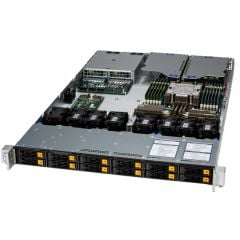
CloudDC A+Server AS-1116CS-TN
Virtualization
HPC
CDN, Edge Nodes
Cloud Computing
Data Center Optimized
Storage Headnode7 361.09 € -
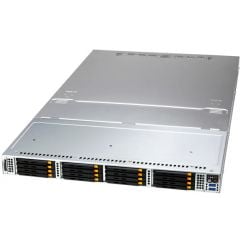
Storage A+ Server ASG-1115S-NE316R
Software-defined Storage
In-Memory Computing
Data Intensive HPC
Private & Hybrid Cloud
NVMe Over Fabrics Solution19 611.12 €